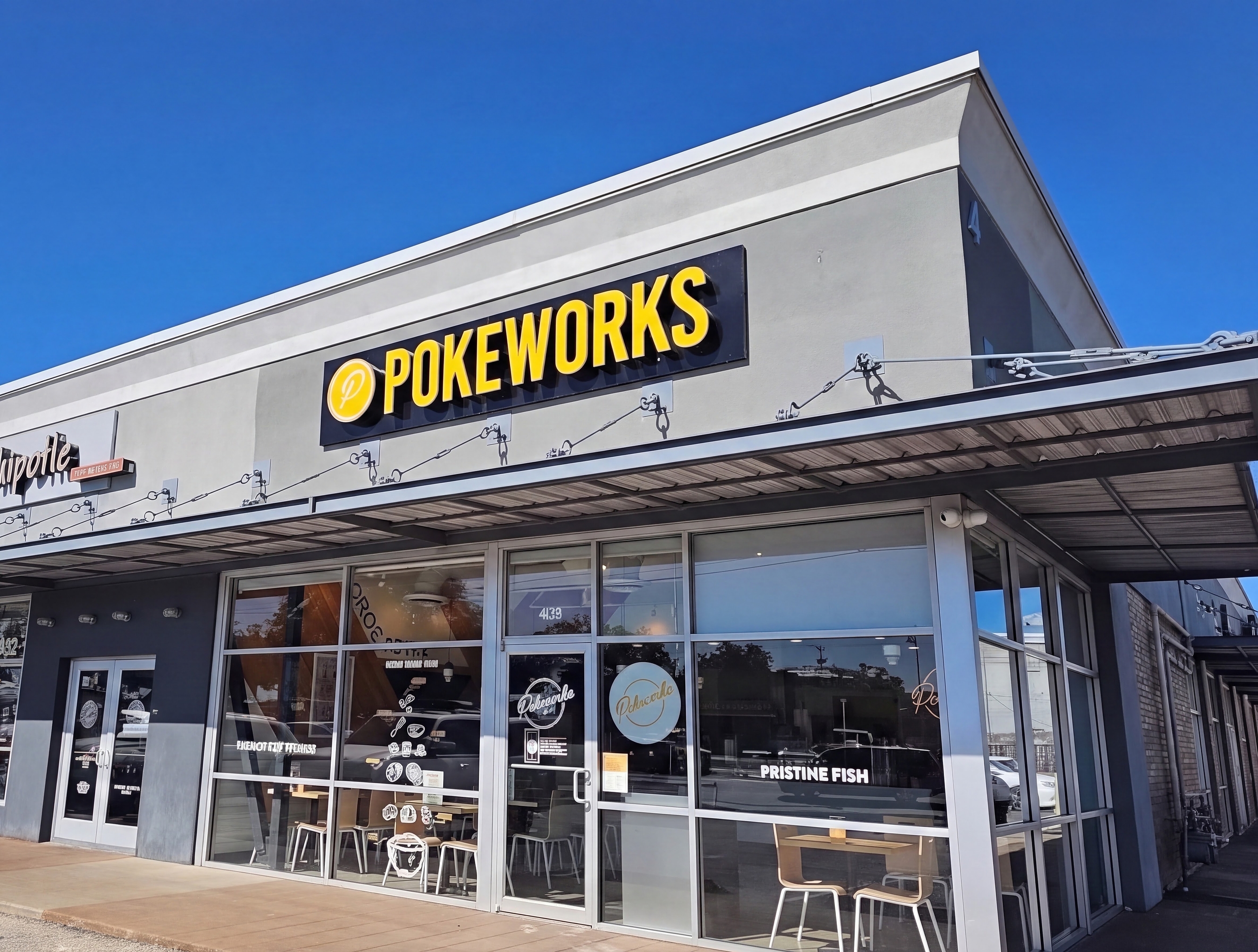
A hood-free, minimal-footprint kitchen design is proving to be a competitive franchise advantage for Pokeworks, as Austin-area franchisees Carol and Marcos Blanco prepare to open their seventh location in Round Rock by end of 2026. The couple's expansion blueprint centers on the brand's stripped-down back-of-house model, which eliminates the need for full-service commercial exhaust hoods and heavy cooking equipment — a spec that fundamentally reshapes how they evaluate real estate.
Kitchen Model Drives Site Strategy
Because Pokeworks does not require traditional hood-dependent cooking lines, the Blancos can consider a far wider range of second-generation spaces than operators running conventional fast-casual concepts. Former coffee shops, boba tea outlets, and juice bars — spaces that typically lack the electrical capacity, gas infrastructure, or plenum height for a full exhaust hood system — become viable candidates. That flexibility directly compresses the buildout timeline and capital outlay. Their Cedar Park location, cited as a prime example, went from lease signing to open in just two months, a pace that would be difficult to achieve in a ground-up or full kitchen renovation scenario.
For equipment specifiers and foodservice consultants working in the fast-casual segment, the Pokeworks model represents a growing category of concepts deliberately engineered around cold-prep and minimal-heat cooking. Operators replacing legacy gas-line builds with cold-assembly formats are finding that second-generation space reuse sidesteps many of the mechanical and ventilation permitting hurdles that can add months to a conventional restaurant buildout. The absence of a Type I hood requirement also removes one of the costliest single line items in a typical kitchen fit-out.
Scaling Without Adding Complexity
Even at seven units, the Blancos operate with a hands-on structure that mirrors their single-store days — Marcos managing daily operations, Carol handling administrative functions. That lean operating model is itself a byproduct of the kitchen's simplicity: fewer pieces of heavy equipment mean lower maintenance overhead, reduced utility demands, and a smaller crew training footprint. Pokeworks Co-founder Peter Yang noted that pairing strong site selection with disciplined operations is the core formula the brand encourages across its 85-location network spanning 22 states, Taiwan, and Canada.
For dealers and equipment reps active in the Texas market, the Pokeworks growth trajectory — six open Austin-area units with a seventh at 2601 Sundance Parkway in Round Rock — signals continued demand for cold-prep smallwares, refrigerated display cases, and light prep equipment rather than heavy cooking suites. The brand's expansion is a useful data point in a broader fast-casual ventilation and energy-use shift that is reshaping how manufacturers position ventless and low-BTU equipment to franchise groups prioritizing site flexibility and faster returns on buildout investment.
Written by Michael Politz, Author of Guide to Restaurant Success: The Proven Process for Starting Any Restaurant Business From Scratch to Success (ISBN: 978-1-119-66896-1), Founder of Food & Beverage Magazine, the leading online magazine and resource in the industry. Designer of the Bluetooth logo and recognized in Entrepreneur Magazine's "Top 40 Under 40" for founding American Wholesale Floral, Politz is also the Co-founder of the Proof Awards and the CPG Awards and a partner in numerous consumer brands across the food and beverage sector.