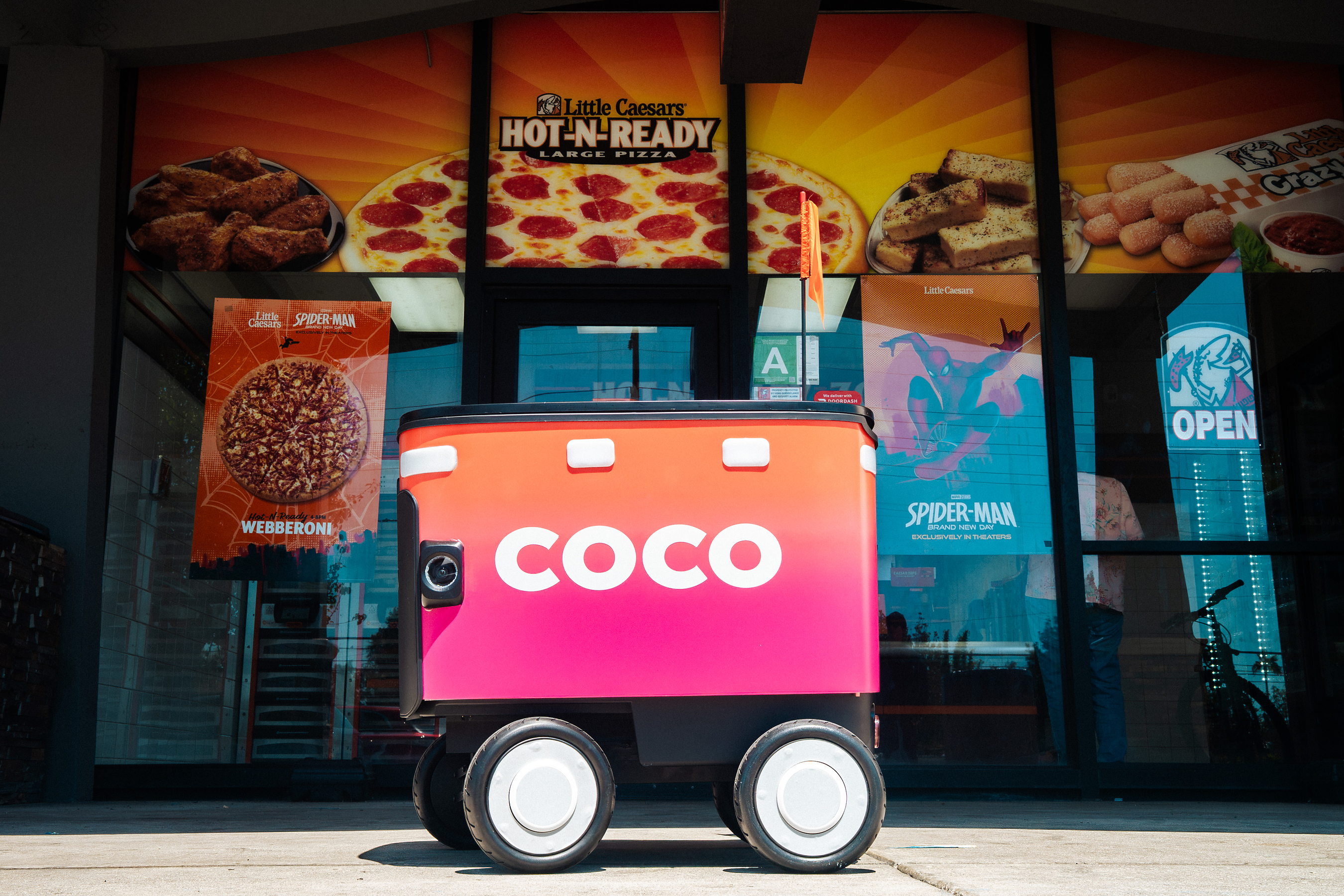
Little Caesars has deployed Coco Robotics autonomous sidewalk robots at participating locations in Los Angeles, Chicago, and Miami, with a San Jose expansion in the pipeline. Orders placed through DoorDash and Uber Eats at qualifying stores can be fulfilled by Coco's robots, completing the final delivery mile from the kitchen curb to the customer's door without driver involvement.
How the Integration Works
The Coco system connects directly into both DoorDash and Uber Eats ordering infrastructure, eliminating any manual ticket entry or separate dispatch step for in-store teams. Once a delivery order is ready, it moves from the kitchen to the sidewalk pickup point, where a Coco robot takes over. For operators, that means no workflow disruption and — according to Little Caesars VP of Innovation Trish Heusel — less in-store congestion during peak periods. "Automating deliveries also reduces congestion in our stores and helps get orders out faster during peak periods," Heusel said.
The back-of-house implication is meaningful for high-volume pizza operations. HOT-N-READY® stores are designed around speed and simplicity, and removing the courier wait at the front counter — or the clustering of third-party drivers inside the store — directly supports that operating model. Operators specifying or retrofitting delivery-forward kitchens are increasingly looking at foodservice automation trends as a way to extend throughput without adding labor.
Scale and Sustainability
Coco reports it has completed more than 500,000 zero-emission deliveries across the U.S. and Europe since its 2020 founding, with its robot fleet continuously trained on real-world urban routing data. The company positions that accumulated mileage as a competitive advantage in rapid market expansion — the same AI and sensor stack deployed in Los Angeles can be adapted to San Jose or Miami without ground-up retraining.
For chain operators and the equipment consultants advising them, autonomous last-mile robotics is becoming a tangible layer of the energy-and-sustainability story alongside induction cooking and heat-recovery ventilation. Each Coco robot runs on battery power, producing no direct emissions per delivery — a factor that aligns with municipal regulations tightening delivery-vehicle rules in dense urban cores like Los Angeles and Chicago.
The program has already drawn industry recognition: the collaboration earned Little Caesars two 2026 Franchise Innovation Awards — Innovator of the Year for Operations & Technology and Most Innovative Use of Technology — signaling that the broader franchised-restaurant sector is watching the rollout closely. With the world's third-largest pizza chain now a reference customer, Coco's enterprise pitch to other QSR and fast-casual brands gains a high-profile proof point.
Written by Michael Politz, Author of Guide to Restaurant Success: The Proven Process for Starting Any Restaurant Business From Scratch to Success (ISBN: 978-1-119-66896-1), Founder of Food & Beverage Magazine, the leading online magazine and resource in the industry. Designer of the Bluetooth logo and recognized in Entrepreneur Magazine's "Top 40 Under 40" for founding American Wholesale Floral, Politz is also the Co-founder of the Proof Awards and the CPG Awards and a partner in numerous consumer brands across the food and beverage sector.