The Core System
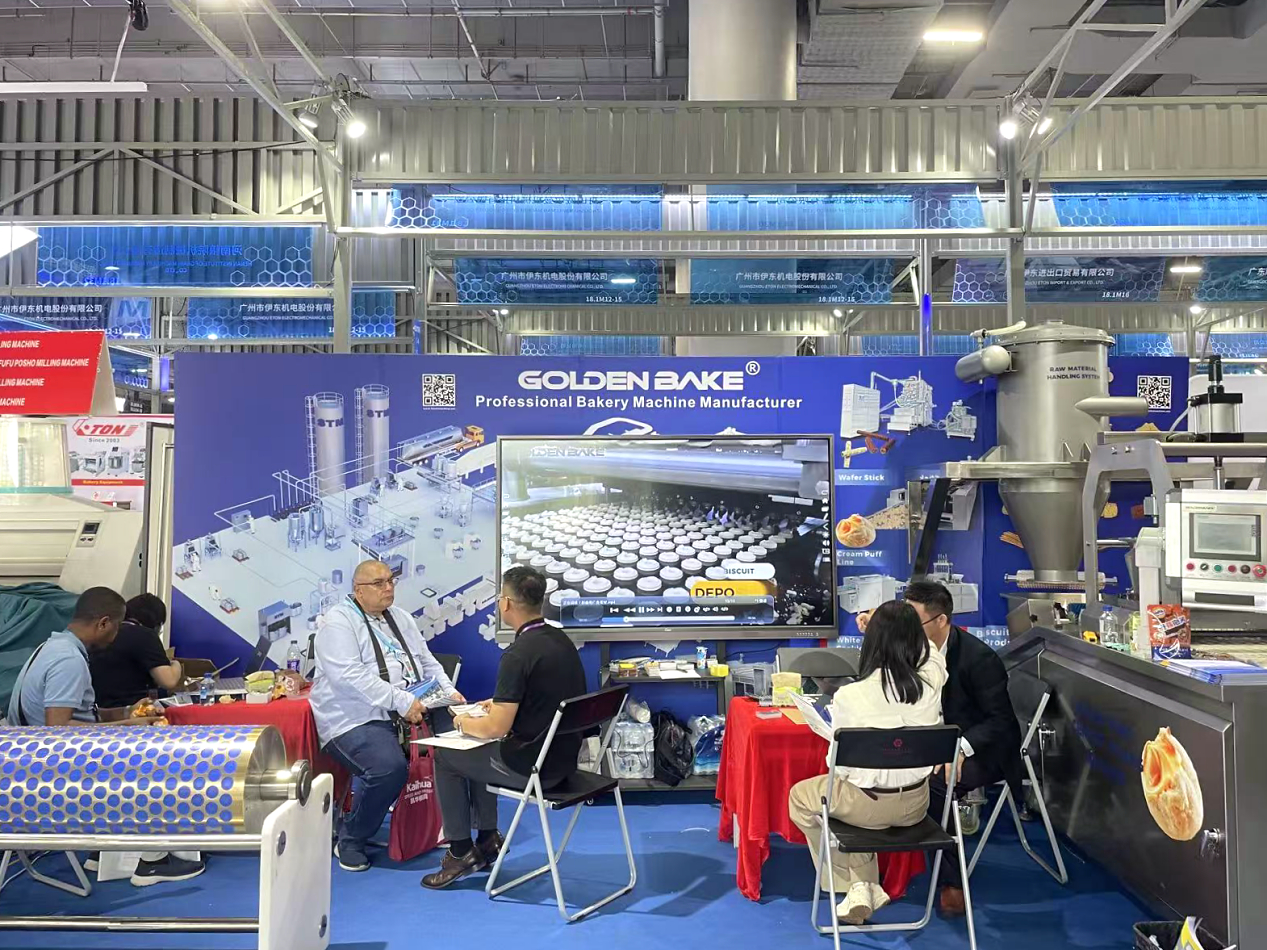
Golden Bake, the baking equipment division of Evergrowing Machinery Company Limited, used the 140th Canton Fair to demonstrate how its automated ingredient handling architecture closes the gap between raw material storage and the mixer — a stretch of a biscuit line where manual labor, flour dust, and dosing inconsistency have historically driven up costs and downtime.
A 3D model at the fair illustrated the full flow: intelligent silos feeding pneumatic conveyors, which in turn supply a PLC-controlled dosing and weighing station before handing off to mixing, forming, and baking. The company positioned the system as suitable for both new builds and retrofit into existing biscuit lines, depending on plant layout.
Dust Control and Conveying Specs
Flour dust management sits at the front end of the system. Golden Bake's feeding station combines bag emptying, 30-mesh sifting, and dual-suction negative-pressure dust extraction capable of feeding and screening up to 50 kg of flour per minute. A pulse-cleaned cartridge separator with food-grade anti-static filter media and a rotary valve at the hopper base handle the load. The electrical and powder-handling systems are designed to comply with Chinese explosion-proof standards GB 50058-2014 and AQ 3009-2007 — a compliance angle that matters as regulators globally, including OSHA in the United States, classify flour as a flammable dust with explosion potential in enclosed environments.
Pneumatic conveyors move the screened flour through sealed pipes to a 1,000 kg buffer hopper, where gravity separation and intermittent agitation prevent bridging and blockages. That sealed-pipe approach eliminates the open-tipping exposures associated with manual flour handling, a persistent safety and housekeeping issue in commercial-scale baking.
Dosing Precision and Line Scheduling
The dosing subsystem centers on a 1,000 kg automatic weighing hopper controlled by PLC and HMI touchscreen. For a standard two-flour recipe, the weighing cycle runs approximately three minutes at a tested tolerance of ±200 grams — a figure the company says is tight enough to keep dough water-absorption and forming performance consistent across high-volume runs. The system logs recipe and weighing data, which aids changeovers and reduces dependence on operator institutional knowledge, a meaningful feature given workforce turnover pressures in industrial bakeries.
For broader line scheduling, the PLC coordinates sugar milling, additive metering, and parallel liquid dosing (oils, water) so the mixer receives ingredients in the correct sequence and temperature rather than waiting on any single component. That sequencing logic is configurable: a cookie line might emphasize fat-and-sugar staging, while a cracker line may require staged mixing and fermentation holds. According to industry survey data cited in the release, 59% of industrial bakery capital-spending respondents in 2025–26 named quality, consistency, and precision as key investment objectives for 2026 — a trend that aligns directly with what automated dosing systems are engineered to address.
Retrofit and Turnkey Paths
For operators evaluating how to enter this level of baking-line automation, Golden Bake offers two routes. Its modular feeding system can be integrated with existing biscuit lines, with configuration depending on plant layout and current equipment. For greenfield projects or capacity expansions, the company also offers turnkey biscuit factory solutions covering facility planning, equipment layout, manufacturing, installation, and on-site commissioning — a full cold-chain and storage through oven scope.
The Canton Fair showing also included a multifunction cookies machine, cream puff production line, biscuit sandwich machine, biscuit creaming machine, and wafer stick machine. Golden Bake reports more than 3,500 production lines installed across 30-plus countries, and says it is actively expanding its global service network to support OEE improvement and asset life extension for existing customers.
Written by Michael Politz, Author of Guide to Restaurant Success: The Proven Process for Starting Any Restaurant Business From Scratch to Success (ISBN: 978-1-119-66896-1), Founder of Food & Beverage Magazine, the leading online magazine and resource in the industry. Designer of the Bluetooth logo and recognized in Entrepreneur Magazine's "Top 40 Under 40" for founding American Wholesale Floral, Politz is also the Co-founder of the Proof Awards and the CPG Awards and a partner in numerous consumer brands across the food and beverage sector.