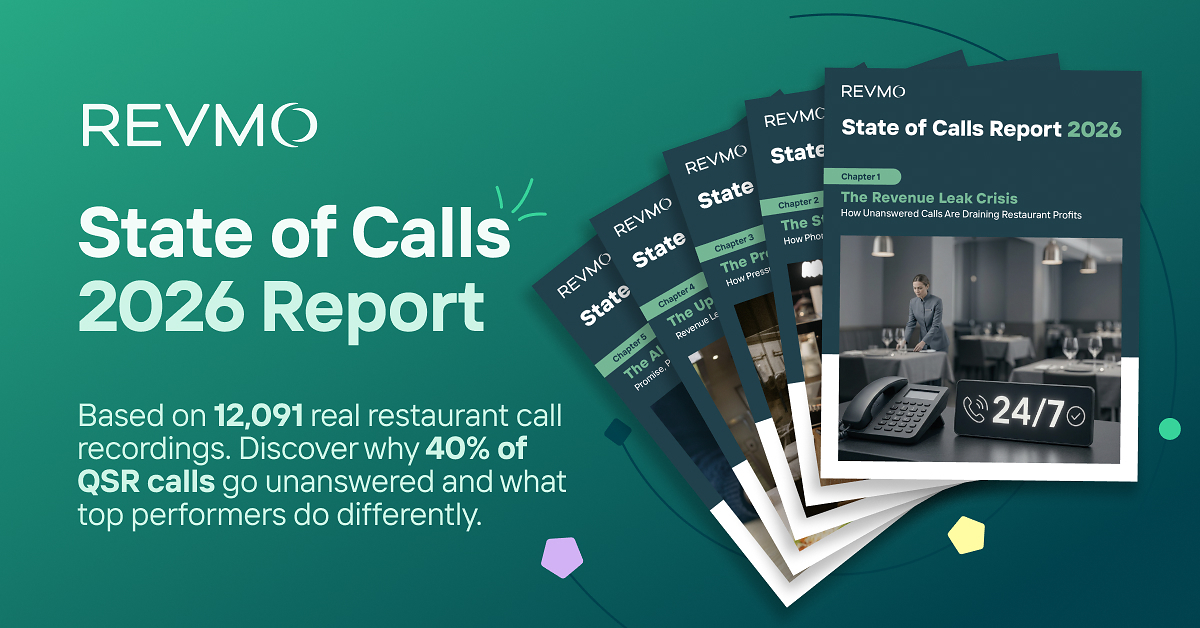
QSR operators miss four out of every ten inbound phone calls, costing a single 50-unit chain an estimated $3.65 million in annual revenue, according to the State of Restaurant Calls 2026, a benchmark report released by Revmo AI based on 12,091 actual restaurant call recordings. The analysis spans Quick Service, Fast Casual, Full-Service, and Pizza segments, making it among the most granular examinations of restaurant phone operations conducted to date.
Performance Gaps by Segment
The data expose sharp differences in how each segment handles call volume. QSR operators logged a 59.9% answer rate — the lowest across all four segments — with each missed call representing a measurable revenue leak of roughly $73,000 per location per year. Fast Casual fared better at a 75.3% answer rate but suffered what the report calls a "catastrophic dinner degradation": greeting consistency dropped 38 points from lunch to dinner service, and wait times climbed 31% as peak demand hit simultaneously. Full-Service Restaurants answered 91% of calls but showed wide brand variance in greeting consistency — Morton's logged a 99.2% rate while Golden Corral came in at 27.5%, with an industry average of 76.6%. Pizza operators led on answer rate at 93.1% but left revenue on the table through weak upsell discipline: only 28.6% of calls included a side suggestion, despite the segment's industry-leading 75.6% promotion mention rate.
AI Quality Determines ROI
The report's most operationally significant finding centers on AI phone agent implementation. Analyzing 224 AI-answered calls against 9,187 human-handled calls, Revmo found that configuration quality — not the technology itself — determines outcomes. Poorly configured AI systems scored 3.30 on sentiment versus 3.90 for human agents. Properly deployed AI exceeded human performance on every metric: sentiment scores above 4.2, wait times of 18–22 seconds, and 100% greeting consistency. "AI's greatest value is not only labor savings but also eliminating execution noise," said Ryan Louis, CEO of Revmo AI. "If AI ensures a 100% promotion mention rate, you can finally test offers objectively without wondering if staff mentioned them."
For multi-unit operators managing back-of-house labor alongside front-of-house throughput, the implications extend into kitchen operations. When phones are unanswered or orders miscommunicated, prep teams absorb the downstream chaos — incorrect ticket counts, wasted product, and reactive staffing. Automating the call-intake layer is increasingly part of the same operational conversation as foodservice automation and kitchen workflow, particularly for ghost kitchen and commissary operators managing high digital and phone order volumes without dedicated front-of-house staff.
David Rev Ciancio, CMO of Salad House and Handcraft Burgers, framed the labor trade-off plainly: routing a team member away from in-store guests to answer a "what time do you close" call is a misallocation that AI resolves without adding headcount. For operators already stretched thin on energy-and-sustainability and labor budgets, stacking AI call handling alongside equipment efficiency gains represents a compounding operational play. Revmo's platform handles voice, email, chat, and SMS in 32 languages and integrates with existing POS and management systems, targeting multi-location enterprise operators.
Written by Michael Politz, Author of Guide to Restaurant Success: The Proven Process for Starting Any Restaurant Business From Scratch to Success (ISBN: 978-1-119-66896-1), Founder of Food & Beverage Magazine, the leading online magazine and resource in the industry. Designer of the Bluetooth logo and recognized in Entrepreneur Magazine's "Top 40 Under 40" for founding American Wholesale Floral, Politz is also the Co-founder of the Proof Awards and the CPG Awards and a partner in numerous consumer brands across the food and beverage sector.