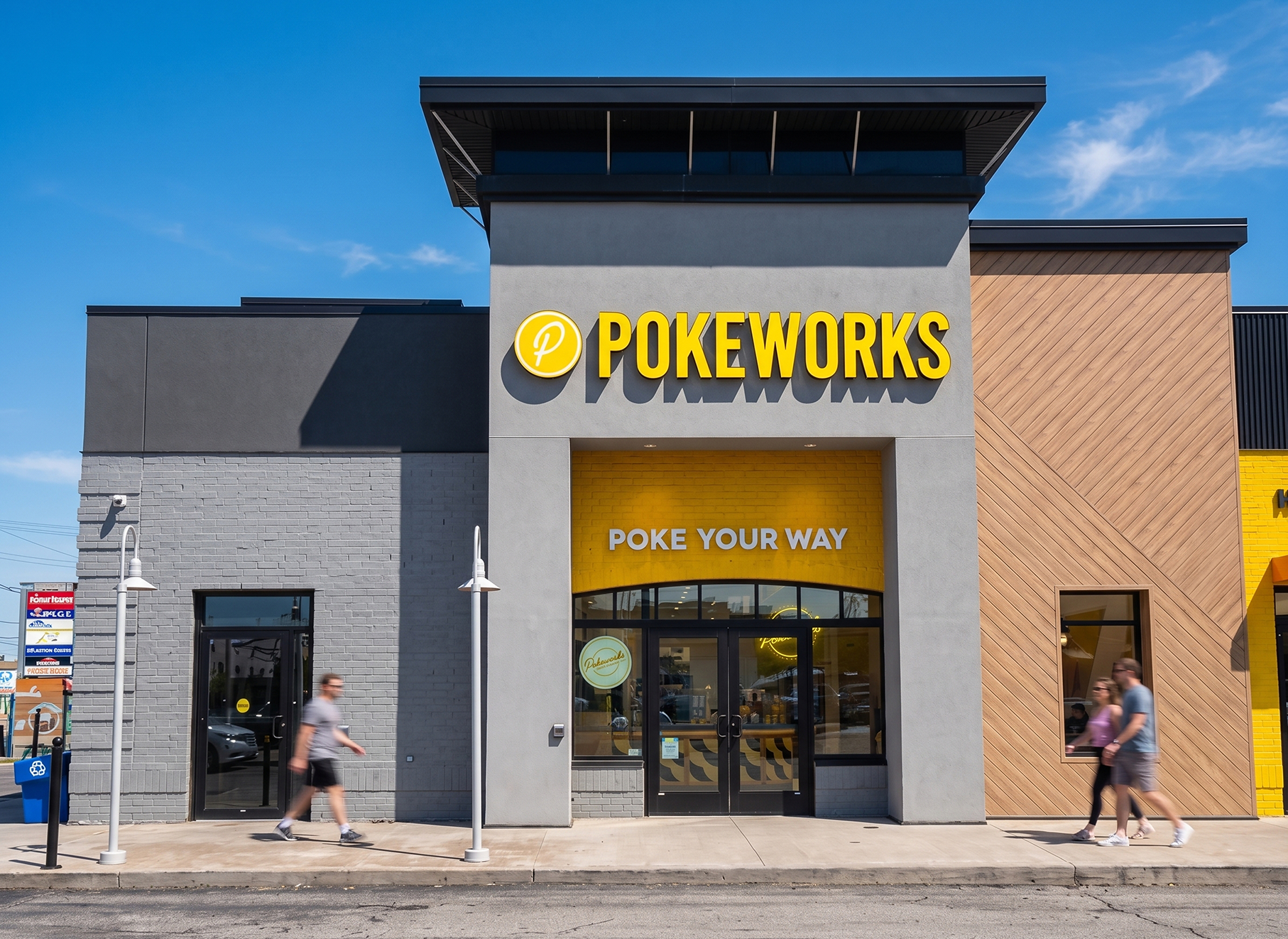
Fast-casual poke chain Pokeworks ended the first half of 2026 with 85 operating locations across 22 states — a 10% year-over-year unit increase — and eight additional sites currently under construction, making it one of the more active commissioning stories in quick-service kitchen buildouts this year. The brand opened five new locations in H1 and signed new multi-unit franchise development agreements, with further expansion planned for New York City, Long Island, California, Denver, Boston, Nashville, and Texas.
Kitchen Build Pipeline
For foodservice consultants and equipment dealers tracking fast-casual pipeline activity, the Pokeworks expansion represents a steady stream of new-build and second-generation kitchen projects. Each location follows the brand's made-to-order poke bowl service model, requiring cold-prep stations, refrigerated ingredient rails, high-velocity refrigeration for raw fish handling, and display cases capable of holding portioned toppings at consistent safe temperatures — a spec set that maps closely to sushi-adjacent cold-chain standards. The brand notes that much of its current growth is being driven by existing franchise partners adding units, a pattern that typically accelerates equipment standardization and streamlines procurement through established dealer relationships. Operators specifying prep-and-storage solutions for protein-forward fast-casual concepts will recognize the cold-hold and portion-control demands inherent in a raw-fish assembly line format.
Protein Bowl and Menu Pressures
Alongside the unit growth, Pokeworks launched its High-Protein Surf & Turf Bowl as a limited-time offering. The bowl combines premium ahi tuna and chicken breast with avocado, surimi salad, double edamame, fresh greens, and chilled ramen noodles, delivering 44 grams of protein and 10 grams of fiber per serving. Menu additions like this intensify back-of-house cold-storage demands, requiring precise temperature management across multiple protein categories simultaneously — raw tuna, cooked chicken, and ready-to-eat components each carrying different HACCP parameters. As fast-casual operators push protein-forward menus in response to consumer demand, the pressure on refrigeration spec at the prep rail and walk-in level continues to grow. Brands scaling at Pokeworks' pace typically revisit walk-in cooler capacity and cold-prep table configurations with each new market entry, particularly when introducing ingredients like raw fish that require tighter temperature tolerances than standard sandwich or grain-bowl competitors.
Pokeworks Co-Founder and Head of Development Peter Yang attributed the momentum directly to franchise partner confidence. "We're especially proud that so much of our growth is coming from franchisees who are expanding their footprint with us," Yang said, noting new market entry along the Central California Coast as a recent milestone. The brand reports that systemwide sales and transaction performance is running at double the industry's year-over-year growth rate, and that sales through its loyalty rewards program have more than doubled over the past two years. Those metrics, combined with eight units under active construction, point to continued demand for kitchen equipment procurement and installation services through the back half of 2026 and into 2027.
Written by Michael Politz, Author of Guide to Restaurant Success: The Proven Process for Starting Any Restaurant Business From Scratch to Success (ISBN: 978-1-119-66896-1), Founder of Food & Beverage Magazine, the leading online magazine and resource in the industry. Designer of the Bluetooth logo and recognized in Entrepreneur Magazine's "Top 40 Under 40" for founding American Wholesale Floral, Politz is also the Co-founder of the Proof Awards and the CPG Awards and a partner in numerous consumer brands across the food and beverage sector.