Food manufacturing lines got a new inspection capability this week as Oxipital AI launched Foreign Material Detection, an AI vision module that identifies contaminants in real time at production line speeds. The system is already operating on production lines at major food producers and targets the contaminant categories most responsible for recalls and regulatory action: hard and soft plastics, wood chips, bone fragments, metal shards, cardboard, and full or partial PPE.
The launch is significant for food and beverage manufacturers who have struggled to unify safety inspection with quality and robotics under a single platform. Rather than adding a standalone X-ray or traditional vision system, operators running Oxipital AI's OX or VX hardware can activate Foreign Material Detection as an integrated capability — reducing vendor count and eliminating separate integration work.
How Detection Works
Oxipital AI's approach leans on synthetic data generation to sidestep a core challenge in contamination detection: real contamination events are rare, making it difficult to build robust training datasets from production footage alone. By simulating the visual signatures of common foreign materials across varied lighting conditions, product types, and line speeds, the company's models arrive production-ready without requiring a plant to wait through contamination incidents to train the system. The company reports detection accuracy of up to 99% in production environments, with precision tuning designed to keep false positives — and unnecessary line stoppages — low.
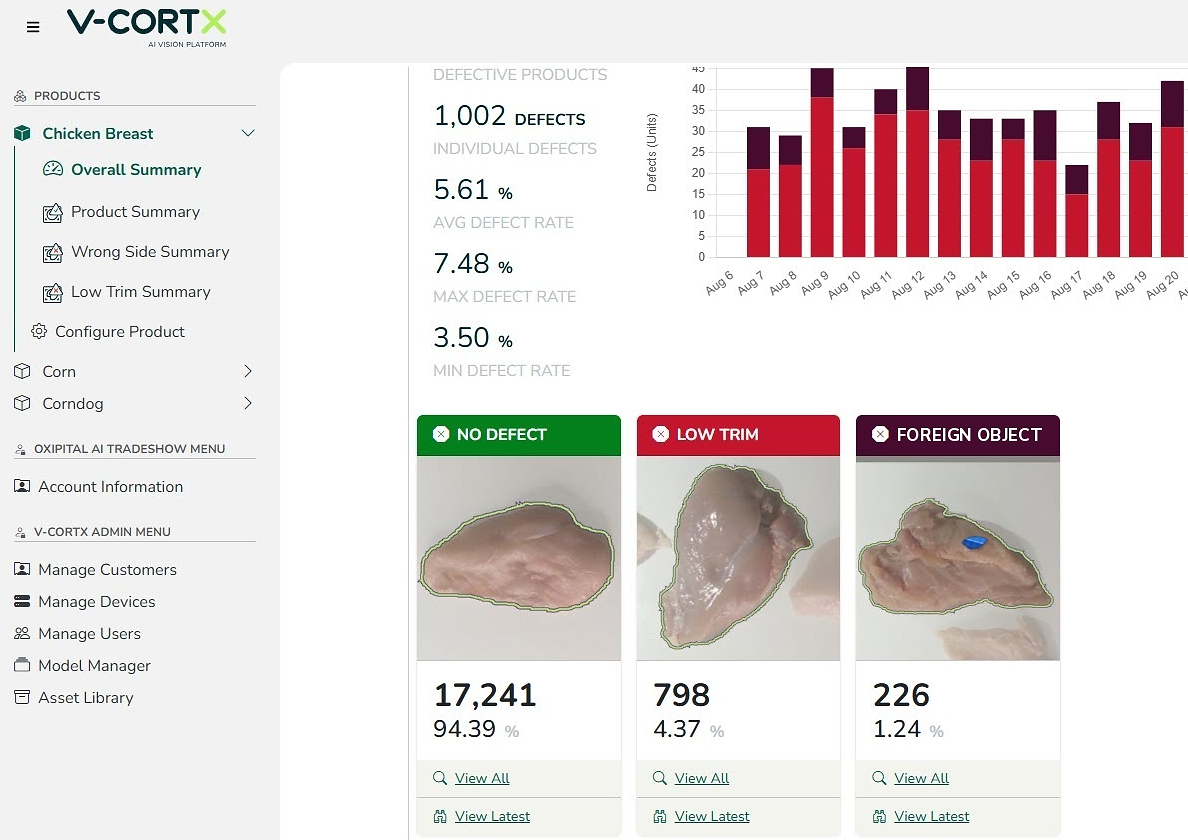
When the system flags a contaminant, it doesn't simply generate an alert. V-CORTX, Oxipital AI's analytics and control platform, integrates directly with existing line control systems to trigger automated responses scaled to severity. A minor anomaly can slow the line; a confirmed high-severity detection stops it entirely without requiring manual intervention. The system also classifies the type of foreign material detected, giving quality assurance and engineering teams the data needed to trace the contamination back to a worn line component, a supplier batch, or a changeover gap — critical intelligence for food safety and cold chain operations downstream.
Audit Trail and Analytics
Every detection event is automatically logged in the V-CORTX dashboard with timestamp, classification, imagery, dimensional data, and throughput impact. That continuous, searchable record is designed to support FSQA documentation and root cause analysis — a growing requirement as regulators tighten traceability mandates across the food manufacturing sector. Plant managers and corporate engineering teams can access the same data feed, giving distributed operations a consistent safety picture across sites.
The unified platform angle resonates with what larger food producers have been pushing for in recent years: fewer point solutions, less integration overhead, and more actionable insight from inspection infrastructure. Oxipital AI CEO Mark Chiappetta noted that customer feedback consistently centered on the need for "fewer vendors, fewer integration headaches, and more confidence in what their inspection system could catch." Foreign Material Detection joins quality inspection and vision-guided robotics as the third pillar of the company's platform, all accessible on hardware already deployed at customer sites.
For foodservice equipment consultants and food production automation specifiers, the ability to add a substantive food safety layer to an existing AI vision deployment — without new hardware procurement — is a meaningful total-cost-of-ownership argument. Operators evaluating capital refreshes on inspection lines should note the OX and VX platform compatibility, which could allow a software-based upgrade path rather than a full equipment replacement cycle.
Oxipital AI is demonstrating Foreign Material Detection live at Pack Expo, booth S-3192, October 18–21.
Written by Michael Politz, Author of Guide to Restaurant Success: The Proven Process for Starting Any Restaurant Business From Scratch to Success (ISBN: 978-1-119-66896-1), Founder of Food & Beverage Magazine, the leading online magazine and resource in the industry. Designer of the Bluetooth logo and recognized in Entrepreneur Magazine's "Top 40 Under 40" for founding American Wholesale Floral, Politz is also the Co-founder of the Proof Awards and the CPG Awards and a partner in numerous consumer brands across the food and beverage sector.