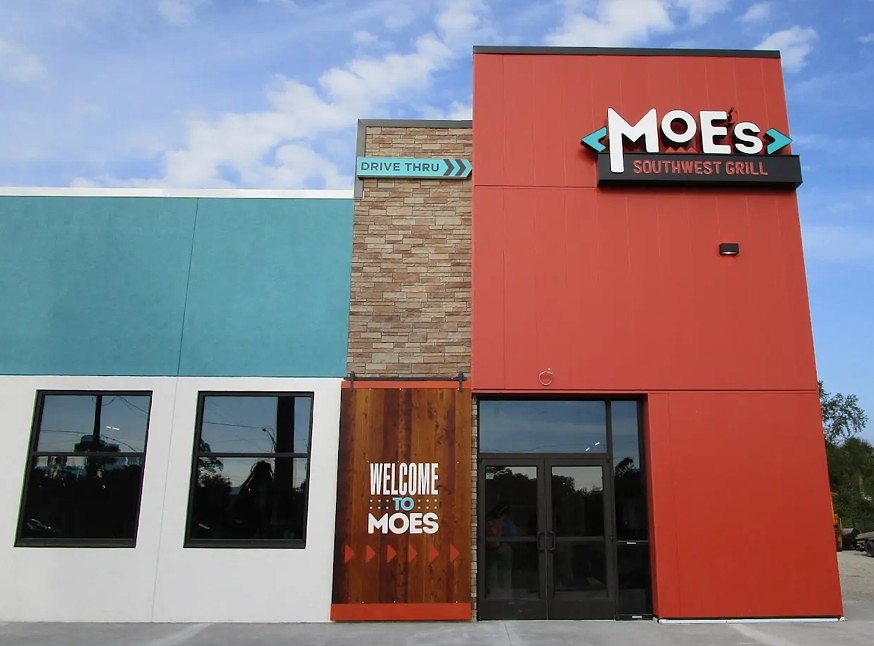
A 2,605-square-foot Moe's Southwest Grill unit opened September 4 in Woodbury, Minnesota, giving the GoTo Foods fast-casual brand its first traditional restaurant footprint in the Twin Cities market. The location at 6671 Valley Creek Road represents a new build-out calibrated for dine-in, takeout, third-party delivery, catering, and digital ordering — the multi-channel service mix now standard in fast-casual kitchen design.
The Build-Out
Franchisee Satnam Dhillon, a Twin Cities resident, owns and operates the Woodbury unit. The 2,605-square-foot floor plan is sized to handle the full Moe's service model, including made-to-order customizable burritos, bowls, stacks, tacos, quesadillas, and nachos across every daypart. For equipment specifiers and kitchen designers tracking fast-casual build-out trends, the layout must accommodate both front-counter assembly lines — the defining production format for Mexican-inspired fast casual — and the back-of-house infrastructure needed to support catering volume and third-party delivery staging. That dual demand is increasingly shaping prep-and-storage configurations in new fast-casual units, where separate hot-holding and cold-holding zones for off-premise orders are becoming baseline spec.
Expansion Plans
The Woodbury opening is explicitly a first step. Dhillon has a second Twin Cities-area location already planned for Apple Valley, making this a multi-unit franchise commitment rather than a single-store trial. For the GoTo Foods development pipeline, the Twin Cities entry follows an existing airport presence at Minneapolis-St. Paul International — a non-traditional format — but the Woodbury unit is the brand's first conventional restaurant in the market. Tatiana Lambert, Chief Development Officer at GoTo Foods, framed the move as part of a broader regional growth strategy, citing consumer demand for fresh, customizable concepts. As of late June 2026, Moe's operated more than 540 locations across 35 states and two countries and territories.
For dealers and consultants active in the Upper Midwest, multi-unit fast-casual franchisees like Dhillon represent a consistent equipment procurement opportunity — new builds typically require full cooking-equipment packages including griddles, warmers, and hot-holding wells, plus refrigerated make-line units, cold storage, and warewashing. The move to support digital ordering and third-party delivery at the unit level also increasingly requires dedicated holding equipment to maintain food quality during courier pickup windows, a spec consideration that is reshaping back-of-house layouts across the fast-casual segment.
Written by Michael Politz, Author of Guide to Restaurant Success: The Proven Process for Starting Any Restaurant Business From Scratch to Success (ISBN: 978-1-119-66896-1), Founder of Food & Beverage Magazine, the leading online magazine and resource in the industry. Designer of the Bluetooth logo and recognized in Entrepreneur Magazine's "Top 40 Under 40" for founding American Wholesale Floral, Politz is also the Co-founder of the Proof Awards and the CPG Awards and a partner in numerous consumer brands across the food and beverage sector.