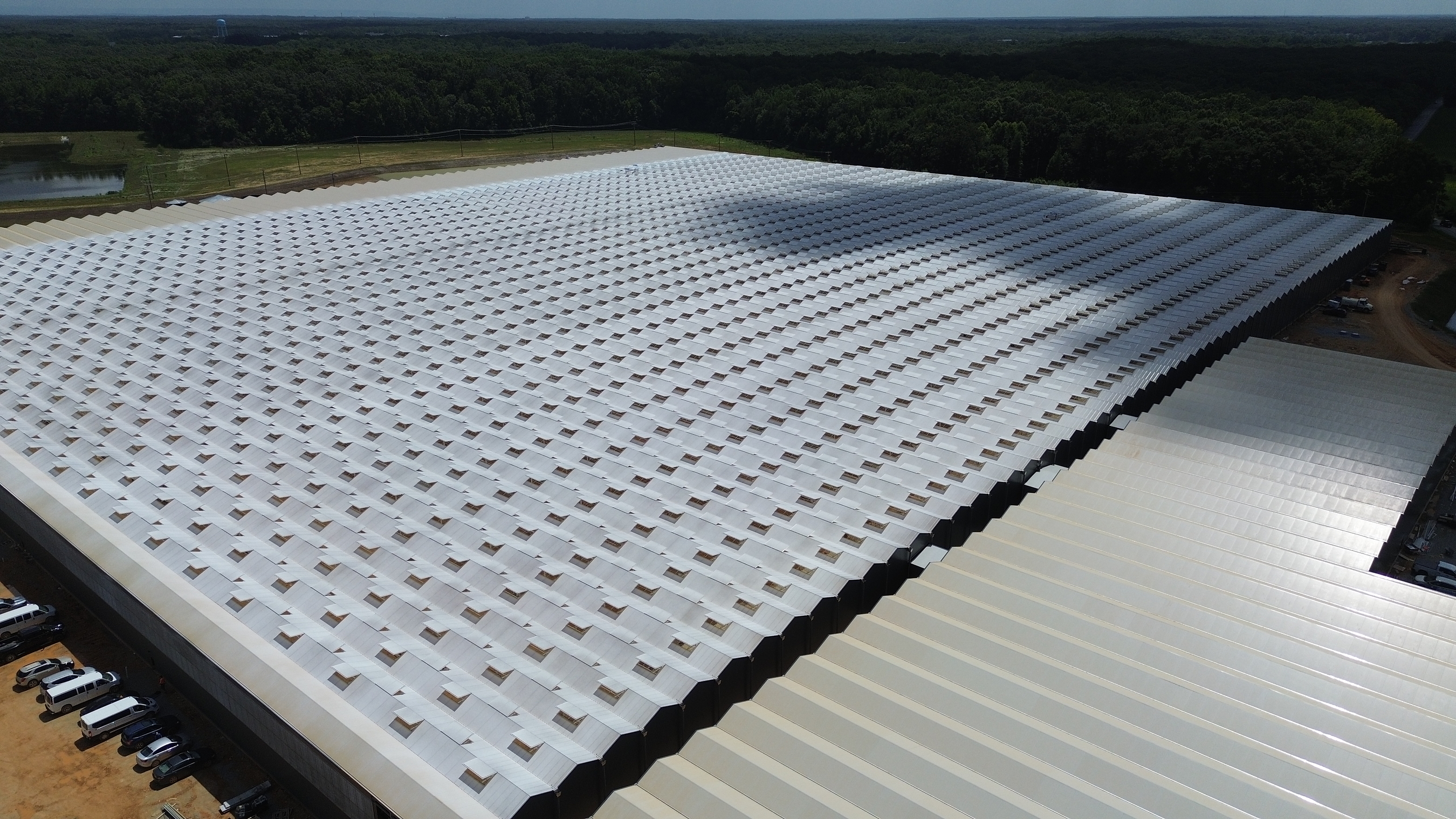
The race to build out large-scale, controlled-environment agriculture (CEA) infrastructure just hit a new benchmark: Little Leaf Farms has begun commissioning a 20-acre greenhouse in Manchester, Tennessee — ahead of its original schedule — with first seeds already planted. The company calls the facility the highest-volume indoor leafy green operation in the world, and it's only phase one of an 80-acre campus.
For foodservice operators, cold chain and storage managers, and commercial kitchen specifiers, the commissioning signals a meaningful step toward a more stable, year-round domestic supply of packaged leafy greens — a category that has faced persistent food safety and availability pressures tied to field-grown product.
The Facility at a Glance
The Manchester campus is Little Leaf Farms' eighth greenhouse and joins existing campuses in Devens, Massachusetts and McAdoo, Pennsylvania. The 20-acre footprint represents the first buildout phase; the site is designed to accommodate expansion to 80 total acres as demand justifies investment. Little Leaf Farms now holds the position of fourth-largest packaged salad brand in the U.S., according to Nielsen pre-packaged salad category data covering total U.S. extended all-outlet combined channels for the 26 weeks through July 11, 2026.
The greenhouse relies on a fully automated growing system in which greens are seeded, grown, harvested, and packaged without direct human contact. Water entering the facility is fully purified to eliminate potential pathogens, and production runs 365 days per year — factors the company markets under its "Clean From the Start" positioning. No pesticides, herbicides, or fungicides are used in the growing process.
Commissary Kitchen Implications
For ghost kitchen operators, commissary kitchens, and high-volume foodservice accounts sourcing fresh leafy greens, additional domestic CEA capacity matters for two reasons: supply consistency and food safety risk profile. Field-grown romaine and spinach have driven repeated cold chain and storage disruptions in recent years, forcing operators to scramble for substitutes mid-contract. Controlled-environment leafy greens produced under automated, pathogen-controlled conditions offer a more predictable inbound ingredient stream, reducing the burden on back-of-house receiving and cold storage teams who must manage fresh produce shelf life.
Scaling production through additional greenhouse campuses also supports the growing infrastructure behind commissary and ghost kitchen buildouts, where operators running high throughput on salad-forward menus need a reliable, traceable supply of pre-packaged greens that can move efficiently through their cold-storage and prep workflows.
Paul Sellew, Founder and CEO of Little Leaf Farms, framed the accelerated timeline as a direct response to retail and foodservice buyer demand: "Retailers are prioritizing a safe, clean, consistent, high-quality supply of leafy greens they can count on year-round. We accelerated our timeline in Tennessee because the market is telling us very clearly that it wants more of what we grow."
What Comes Next
Little Leaf Farms says it is in active discussions for several additional campus locations as it pushes toward a full national footprint. The official opening celebration for the eighth greenhouse is expected in the coming months. With the Tennessee site's 80-acre expansion ceiling, the company is positioning Manchester as a long-term production anchor for the South and mid-South distribution corridor — a region underserved by existing CEA capacity and well-situated for next-day cold-chain delivery to major foodservice distribution hubs.
Written by Michael Politz, Author of Guide to Restaurant Success: The Proven Process for Starting Any Restaurant Business From Scratch to Success (ISBN: 978-1-119-66896-1), Founder of Food & Beverage Magazine, the leading online magazine and resource in the industry. Designer of the Bluetooth logo and recognized in Entrepreneur Magazine's "Top 40 Under 40" for founding American Wholesale Floral, Politz is also the Co-founder of the Proof Awards and the CPG Awards and a partner in numerous consumer brands across the food and beverage sector.