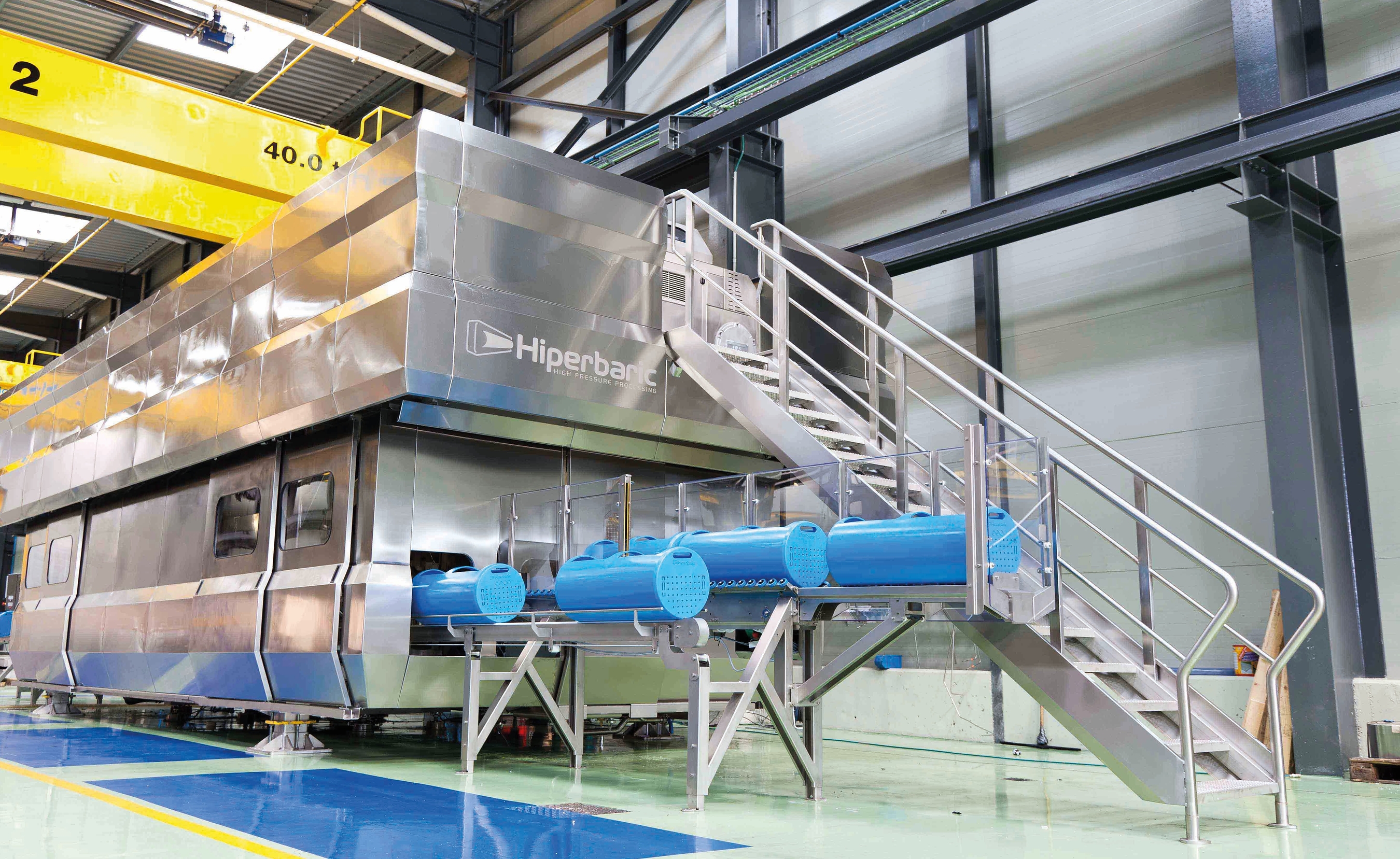
High-pressure processing equipment manufacturer Hiperbaric will bring its most productive system to date — the Hiperbaric 525 (H525) with 12 intensifiers — to PACK EXPO International 2026 (October 18–21, McCormick Place, Chicago, Booth #LU-7718), targeting food and beverage processors squeezed for both throughput and floor space.
The H525 completes up to 10.7 cycles per hour on a 525-gallon (150-liter) vessel operating at 6,000 bar (600 MPa / 87,000 psi), a working pressure consistent with full pasteurization-equivalent pathogen reduction. Hiperbaric states the cycle rate outperforms comparably configured competitor systems tested at the same 6,000 bar pressure, 3-minute holding time, and 60 Hz frequency — a direct response to processors running out of building capacity before running out of demand.
Two Footprint Options
The H525 ships in two configurations designed around real facility constraints. The Standard layout places all 12 intensifiers at floor level alongside the pressure vessel, requiring 1,000 square feet at a machine height of 8.9 feet — suited to facilities without elevated ceiling clearance. The Integrated configuration mounts the intensifiers on a built-in mezzanine platform above the vessel, shrinking the ground-floor footprint to 940 square feet while raising the overall height to 16.5 feet. That recovered floor space can absorb upstream or downstream automation, additional equipment, or pedestrian traffic lanes — a meaningful advantage for processors retrofitting HPP into an existing production building.
Operators already running an H525 aren't locked out of the upgrade: current units in either configuration can be brought up to 12 intensifiers, and existing Standard machines can be converted to the full Integrated mezzanine platform, giving current customers a path to peak throughput without committing to a new machine purchase. For cold chain and storage operations where HPP complements blast chilling or modified-atmosphere packaging lines, the configurable footprint eases line integration planning considerably.
Ergonomics and Serviceability
Beyond throughput, Hiperbaric engineered the H525 around two operator pain points: physical labor and unplanned downtime. A fully integrated return conveyor eliminates up to 20,000 pounds of manual canister lifting per shift — a figure that resonates with processors facing labor shortages and workers' compensation exposure. On the maintenance side, each of the 12 intensifiers is independently isolatable, allowing technicians to service a single unit while the remaining intensifiers keep the machine running. Hiperbaric says this design is unique to its platform in the HPP industry, and because the company manufactures its intensifiers in-house, it continuously refines them against field data from an installed base that now exceeds 450 machines globally.
"Processors are being asked to do more with the same building," said Rob Peregrina, USA Executive Director of Hiperbaric. "The 525 with 12 intensifiers gives them the highest throughput we've ever built into a 525-gallon platform, and the Integrated configuration delivers that throughput in a footprint that's a fraction of what comparable systems require."
Every H525 ships with Hiperbaric's HPP Support Program at no ongoing cost: 24/7 remote troubleshooting, on-site field engineers within 24–48 hours, spare parts warehouses in the USA, Mexico, Spain, and New Zealand committing to sub-24-hour shipment, an Uptime customer portal, complimentary food science process support, and an annual maintenance training workshop held in Burgos, Spain. For specifiers evaluating total cost of ownership alongside capital cost, the bundled service program is a differentiator worth documenting in equipment schedules.
Hiperbaric will also present "Clean Label Meets Food Safety with High Pressure Processing" at the Processing Innovation Stage (Booth LU-7764) on Monday, October 19, from 10:00 to 10:30 AM, covering how HPP inactivates vegetative pathogens while preserving sensory quality — relevant context for operators and consultants specifying energy-and-sustainability profiles for non-thermal preservation lines.
Written by Michael Politz, Author of Guide to Restaurant Success: The Proven Process for Starting Any Restaurant Business From Scratch to Success (ISBN: 978-1-119-66896-1), Founder of Food & Beverage Magazine, the leading online magazine and resource in the industry. Designer of the Bluetooth logo and recognized in Entrepreneur Magazine's "Top 40 Under 40" for founding American Wholesale Floral, Politz is also the Co-founder of the Proof Awards and the CPG Awards and a partner in numerous consumer brands across the food and beverage sector.