
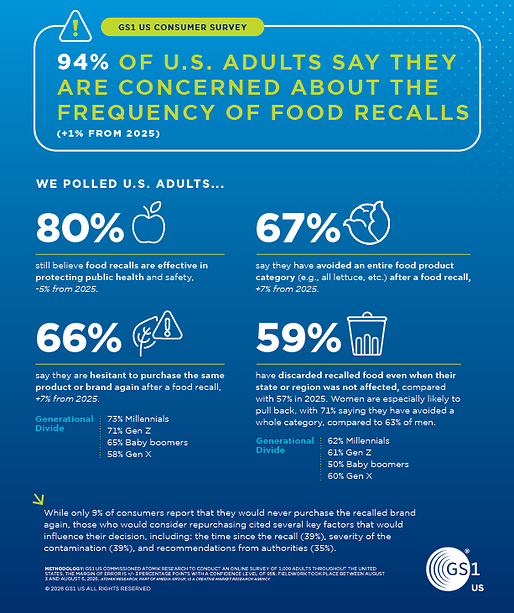
Ninety-four percent of U.S. adults say they are concerned about the frequency of food recalls — up from 93% in 2025 — while confidence that recalls actually protect public health has slipped from 85% to 80% in the same period, according to a new consumer survey commissioned by GS1 US. For foodservice operators, distributors, and the equipment specifiers who design the cold-chain and storage infrastructure behind commercial kitchens, the data represents a tightening regulatory and reputational backdrop.
Consumer Behavior Shifting
The survey documents a sharp rise in precautionary consumer behavior following food safety incidents. Sixty-seven percent of respondents said they have avoided an entire food product category after a recall — up from 60% in 2025 — while 66% expressed hesitancy to purchase the same brand again, compared with 59% the prior year. Even more striking for supply-chain operators: 59% discarded recalled food even when their own state or region was not affected. That broad-brush avoidance amplifies the commercial damage of imprecise recalls and makes lot-level tracking — tied to specific production runs, storage units, and distribution legs — an increasingly urgent operational priority.
"The challenge is making recall response more precise so companies can quickly identify and remove affected products while giving consumers clearer information about what is — and is not — impacted," said Bob Carpenter, president and CEO of GS1 US. "Traceability, supported by common standards and better data sharing across the supply chain, is essential to that effort."
FSMA 204 and the 2028 Clock
The regulatory driver behind much of this urgency is the FDA's Food Safety Modernization Act (FSMA) Section 204 Food Traceability Rule, which takes effect July 20, 2028. The rule targets high-risk foods — including leafy greens and eggs — and requires companies to maintain Key Data Elements at Critical Tracking Events and furnish that data to the FDA within 24 hours upon request. For foodservice operators running commissary or cold-chain storage operations, compliance means having the infrastructure — refrigeration systems with lot-linked logging, inventory software tied to receiving records, and label scanning at every handoff — to reconstruct a product's journey on demand.
GS1 US is actively publishing implementation guidance, including a dedicated FSMA Rule 204 guideline that maps GS1 Standards to the regulation's recordkeeping requirements. The organization is also advancing adoption of 2D barcodes — specifically QR Codes powered by GS1, part of its Sunrise 2027 initiative — on product packaging. Those richer codes can carry batch and lot information readable at the point of sale or receiving dock, giving both trading partners and end consumers more-precise data when a safety event occurs.
Implications for Kitchen Infrastructure
For equipment dealers and consultants specifying refrigeration and cold storage for commercial kitchens, ghost kitchens, and commissary operations, the survey and regulatory timeline together create a concrete equipment-specification argument. Walk-in coolers and reach-ins with integrated temperature logging, smart shelving with barcode-reader compatibility, and receiving stations designed for 2D-barcode scanning are no longer simply value-adds — they become compliance enablers as FSMA 204 enforcement approaches. Operators replacing legacy cold-storage units in the next two years should be factoring lot-traceability readiness into their equipment specifications now, rather than retrofitting after the 2028 compliance date.
The broader energy-and-sustainability conversation around refrigeration upgrades also intersects here: newer, more efficient refrigeration platforms are increasingly built with digital connectivity that supports the kind of continuous environmental and inventory logging FSMA 204 demands, meaning a single capital investment can serve both an energy-reduction and a food-safety-compliance goal.
Written by Michael Politz, Author of Guide to Restaurant Success: The Proven Process for Starting Any Restaurant Business From Scratch to Success (ISBN: 978-1-119-66896-1), Founder of Food & Beverage Magazine, the leading online magazine and resource in the industry. Designer of the Bluetooth logo and recognized in Entrepreneur Magazine's "Top 40 Under 40" for founding American Wholesale Floral, Politz is also the Co-founder of the Proof Awards and the CPG Awards and a partner in numerous consumer brands across the food and beverage sector.