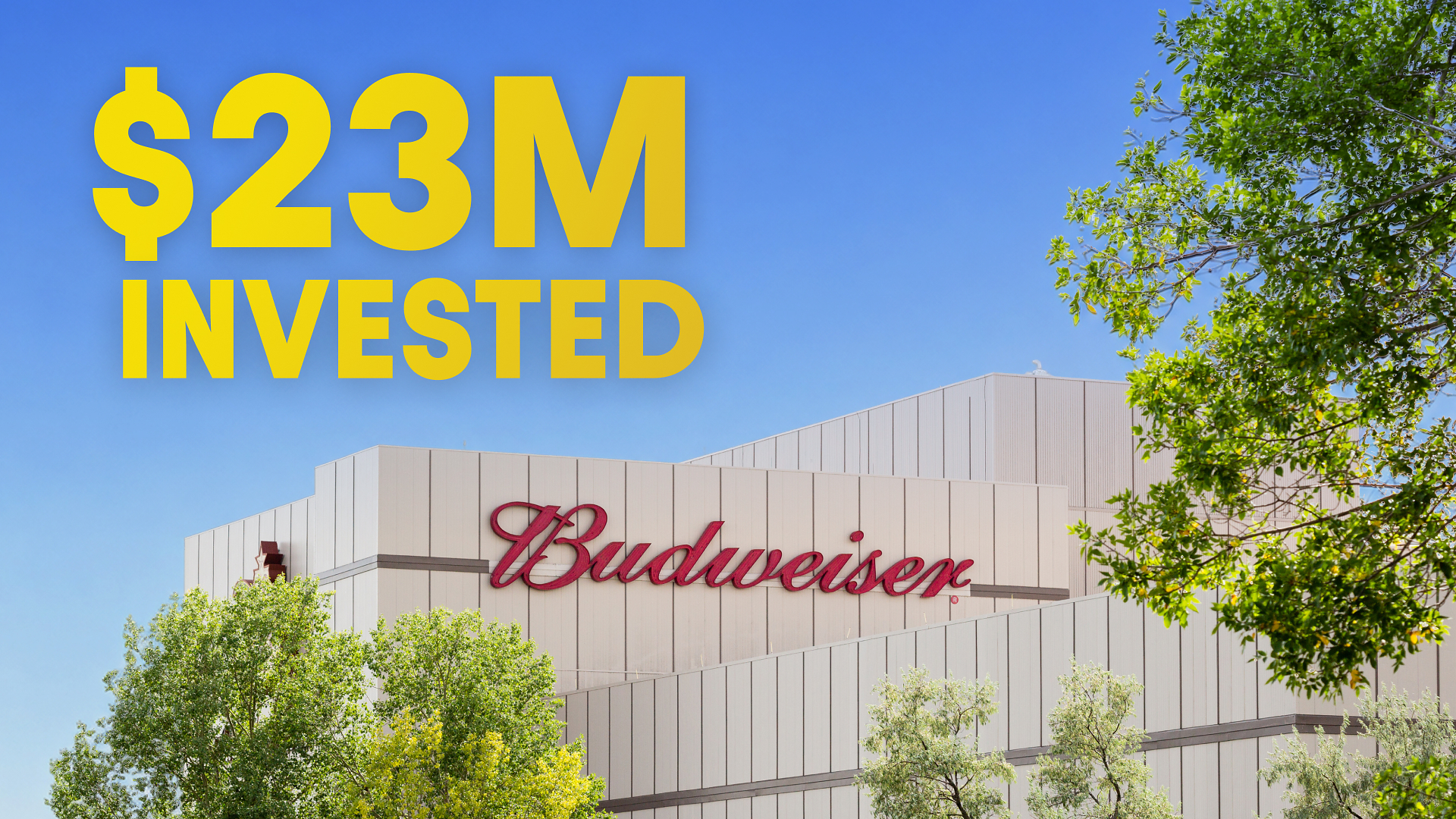
A $23 million capital investment at Anheuser-Busch's Fort Collins, Colorado brewery will expand production capacity for Michelob ULTRA, add 25-oz can packaging capability, and open a new technical skills training center — one of 15 the brewer is standing up across its national network.
The Fort Collins facility, which has operated since 1988 and produces more than 48 brands, receives this infusion as part of Anheuser-Busch's broader Brewing Futures initiative, under which the company is directing $600 million toward U.S. operations across 2025 and 2026. Total capital deployed at the Fort Collins site since 2021 now reaches $93 million.
Production & Infrastructure Upgrades
The packaging addition — tooling for 25-oz can formats — reflects growing consumer demand for larger single-serve alcohol formats, a trend that has rippled through filling line specifications at major production breweries. Alongside the packaging line work, the investment will increase the facility's rail capacity, reinforcing inbound ingredient flow and outbound route-to-market logistics. For foodservice and cold chain and storage operators sourcing packaged beer for stadium, arena, or large-venue accounts, wider SKU availability in high-volume can formats can simplify procurement.
Workforce & Equipment Training
Perhaps the most operationally significant element for the broader manufacturing industry is the new technical skills training center opening inside the Fort Collins brewery. The center will focus on upskilling operators and technicians in electrical and mechanical systems tied directly to brewery equipment — conveyors, fillers, pasteurizers, and the control systems that run them. Anheuser-Busch says it plans to upskill more than 90% of its manufacturing workforce over the next five years across all 15 training centers nationwide.
This kind of in-house, equipment-specific credentialing mirrors a trend visible across large-scale food and beverage production facilities, where energy-and-sustainability pressures and increasing automation are forcing operators to close skills gaps internally rather than rely solely on OEM service networks. Ghost kitchen operators and commissary builders watching large-scale beverage production can draw a direct parallel: the equipment complexity entering centralized production kitchens today demands the same structured technician training that breweries have long prioritized.
CEO Brendan Whitworth framed the investment squarely around domestic manufacturing confidence: "Investments at this scale help fuel economic growth, create and sustain high-quality jobs, and reinforce our long-term commitment to the communities where we live and work."
The Fort Collins Brewery also serves a dual-use role as one of only two Anheuser-Busch facilities — alongside the Cartersville, Georgia plant — configured to produce emergency drinking water. The company reports it has produced more than 100 million cans of emergency water for disaster-affected communities since 1988, a capability that depends on production line flexibility that mirrors the kind of rapid changeover specs that foodservice equipment specifiers increasingly demand from high-volume cooking-equipment and filling platforms.
Written by Michael Politz, Author of Guide to Restaurant Success: The Proven Process for Starting Any Restaurant Business From Scratch to Success (ISBN: 978-1-119-66896-1), Founder of Food & Beverage Magazine, the leading online magazine and resource in the industry. Designer of the Bluetooth logo and recognized in Entrepreneur Magazine's "Top 40 Under 40" for founding American Wholesale Floral, Politz is also the Co-founder of the Proof Awards and the CPG Awards and a partner in numerous consumer brands across the food and beverage sector.