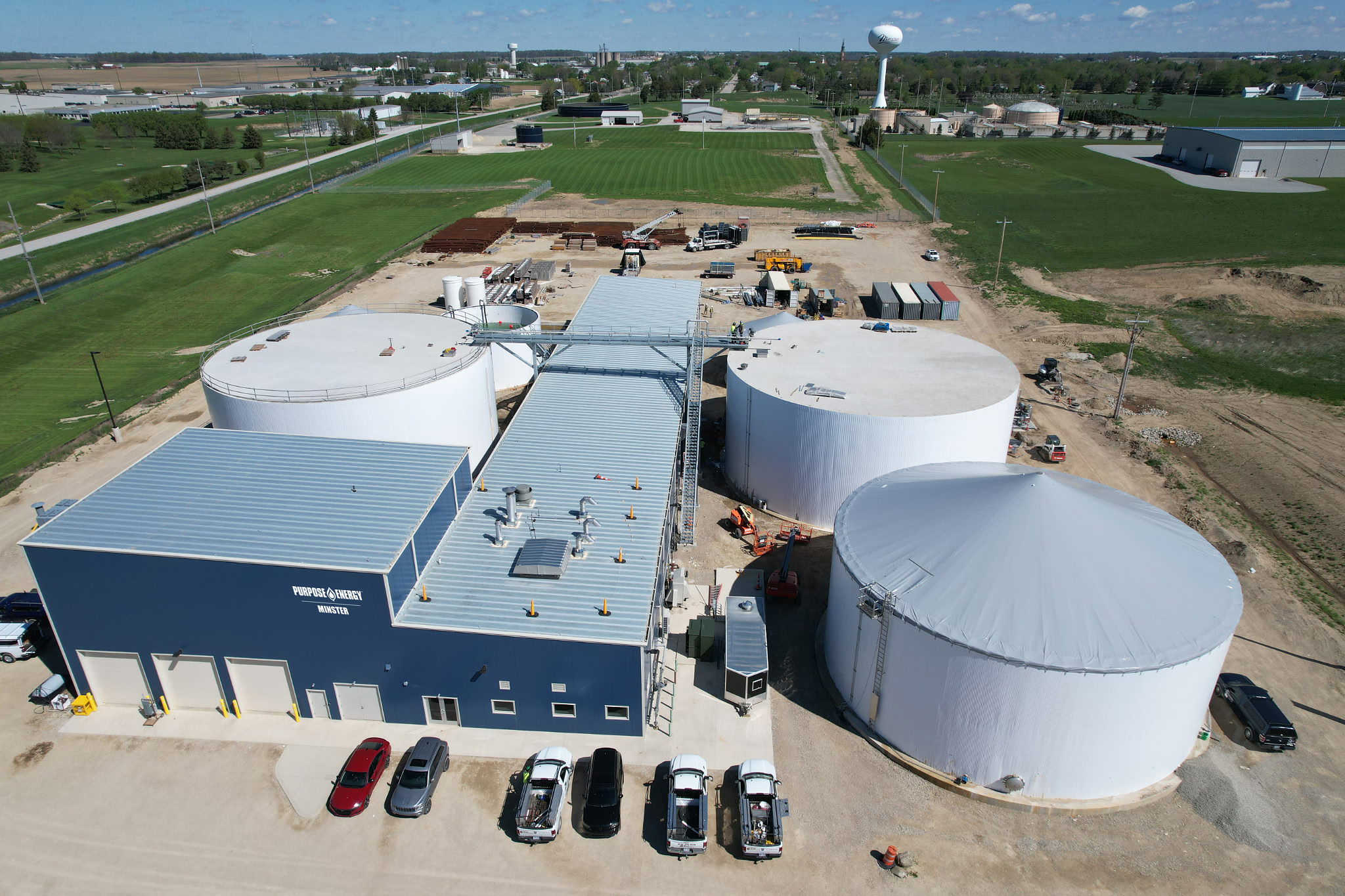
A $40 million industrial anaerobic digestion facility built by PurposeEnergy in Minster, Ohio is now operational, converting up to 250,000 gallons per day of yogurt-production residuals and high-strength organic waste into renewable biogas, treated water, and nutrient-rich soil amendments. The project — the company's first with Danone USA — marks one of the more concrete examples of a large food manufacturer closing the loop between back-of-house waste streams and on-site energy supply.
How the System Works
Residuals from Danone USA's largest U.S. yogurt manufacturing plant are piped directly to the PurposeEnergy facility, located less than a mile away in Minster's Route 66 Industrial Park. At full ramp, the digester is projected to produce approximately 50,000 MMBtu of biogas per year. That gas travels back to Danone's Minster plant via a dedicated pipeline, where it fires a new biogas boiler that displaces conventional natural gas for process heat — the kind of thermal load that dominates commercial dairy and yogurt production. Using EPA and EIA combustion emission factors, PurposeEnergy calculates the displacement equals roughly 3,200 U.S. tons of CO2e per year. Eliminating off-site residual hauling adds another estimated 720 tons of CO2e in annual avoidance.
The facility also treats process water to exceed the Village of Minster's municipal discharge standards before it reaches the local wastewater treatment works — a community infrastructure benefit that local officials cited as a primary driver of municipal support for the project. Heiko Gerling, chief operating officer of Danone Americas, described the project as part of the company's broader Re-Fuel energy excellence program, noting that "operational growth and environmental stewardship can go hand in hand."
Implications for Food Manufacturers
For foodservice equipment specifiers and commissary kitchen designers, the Minster project illustrates a growing infrastructure model: large-volume food manufacturers — yogurt plants, protein processors, beverage co-packers — generating enough high-strength organic waste to justify dedicated on-site or near-site digestion assets. The economics hinge on waste volume and proximity; at 250,000 gallons per day, Danone's Minster operation sits well above the threshold that typically justifies a private-infrastructure approach versus hauling to a municipal facility.
PurposeEnergy finances, builds, owns, and operates each digester for the life of the project under a service model, meaning the food manufacturer avoids capital outlay and ongoing operational complexity. That structure is gaining traction as food and beverage producers face tighter energy-and-sustainability targets while also managing rising disposal costs for high-BOD waste streams — a category that includes dairy, juice, brewing, and prepared-food production.
The Minster facility is currently ramping toward full capacity, with a formal grand opening celebration planned for spring 2027. Operators and consultants tracking cold chain and back-of-house waste handling at large commissary and manufacturing scale will want to watch how this model replicates across PurposeEnergy's broader project pipeline, which is backed by infrastructure investor Quinbrook.
Written by Michael Politz, Author of Guide to Restaurant Success: The Proven Process for Starting Any Restaurant Business From Scratch to Success (ISBN: 978-1-119-66896-1), Founder of Food & Beverage Magazine, the leading online magazine and resource in the industry. Designer of the Bluetooth logo and recognized in Entrepreneur Magazine's "Top 40 Under 40" for founding American Wholesale Floral, Politz is also the Co-founder of the Proof Awards and the CPG Awards and a partner in numerous consumer brands across the food and beverage sector.