Long before a dish reaches the dining room, every great meal begins with a series of small, nearly invisible decisions. The first cut of a tomato. The paper-thin slice of yellowtail. The precise chiffonade of basil that lands effortlessly atop a finished plate. While guests remember flavors, chefs understand that exceptional cooking is often built upon exceptional tools.
For more than a century, Seki City, Japan, has remained one of the world's most respected centers of blade-making, a legacy dating back to the craftsmanship of traditional samurai swordsmiths. Today, that heritage continues through companies like Kai Corporation, whose Shun Cutlery line has become synonymous with Japanese precision, meticulous craftsmanship, and functional artistry. Every Shun knife is still handcrafted in Seki through a process involving more than 100 individual manufacturing steps—a level of detail that remains increasingly uncommon in today's world of large-scale production.
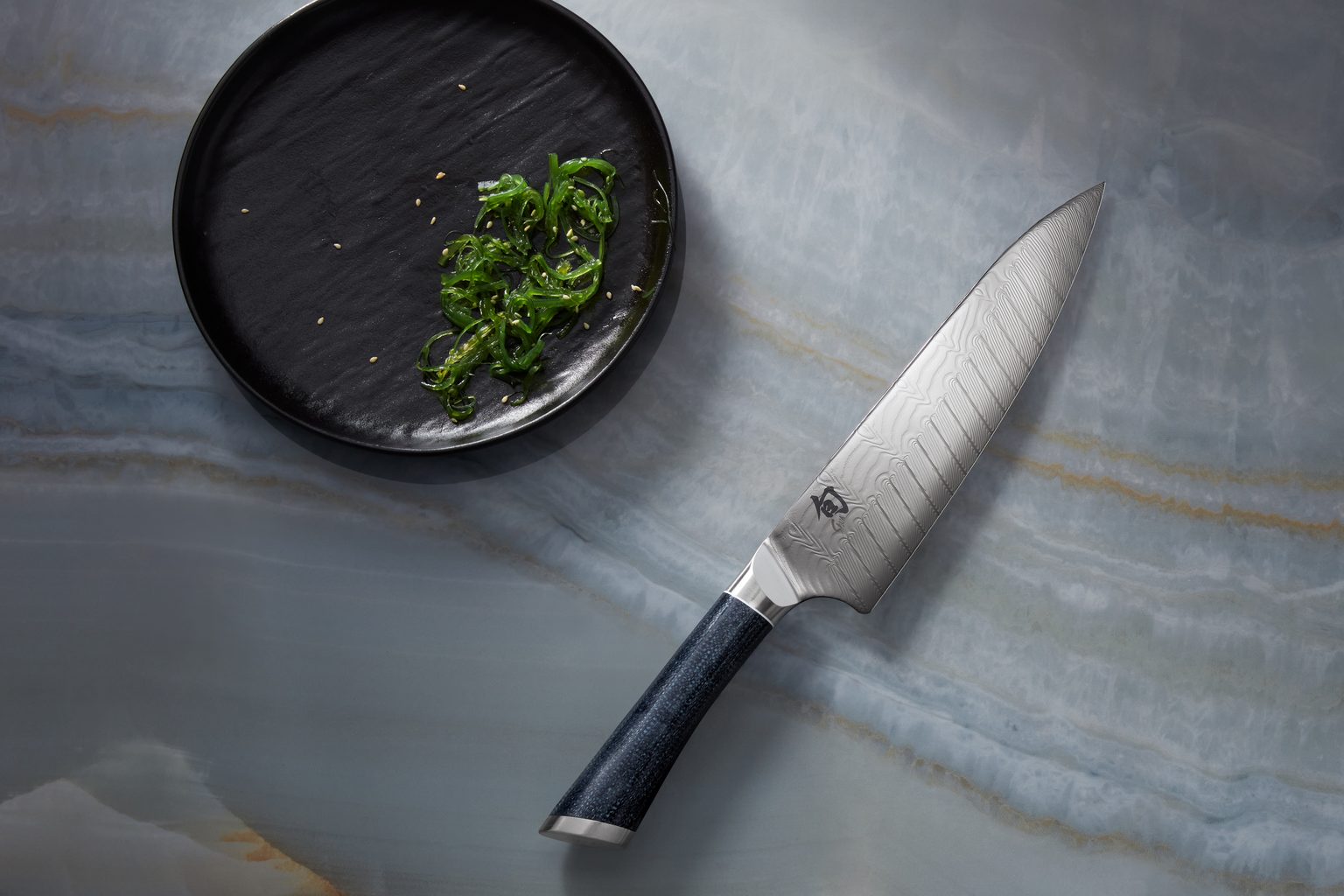
This year, Shun expanded that legacy with the introduction of the Shiranami collection, an elevated series that represents one of the company's most ambitious releases to date. Named after the Japanese word shiranami, meaning "white-capped wave," the collection draws inspiration from the movement of ocean surf, translating that natural rhythm into a blade whose flowing Damascus pattern is as functional as it is visually striking.
Dual-Core Construction and Precision Engineering
The centerpiece of the collection is the Shiranami Chef's Knife, an eight-inch workhorse that demonstrates how thoughtful engineering and traditional craftsmanship can coexist. Rather than relying on decorative Damascus layering alone, Shun employs a dual-core construction composed of alternating VG10 and VG2 high-carbon stainless steels. Seventy-one micro-layers are forge-welded and roll forged together before being hand-sharpened to a precise 16-degree edge on each side. The result is a blade engineered for remarkable edge retention, exceptional sharpness, and clean, effortless cutting.
That level of refinement matters more than many consumers realize.
Within professional kitchens, consistency is measured in fractions rather than inches. A cleaner cut preserves delicate herbs. Less cell damage means vegetables oxidize more slowly. Fish maintains its texture. Proteins portioned more evenly. While diners rarely notice the knife itself, they experience its influence throughout every course.
A Japanese Philosophy of Precision
It is this philosophy that has long distinguished Japanese knife-making from many Western traditions. Rather than emphasizing weight and brute force, Japanese blades are designed around precision, balance, and efficiency. The knife becomes an extension of the chef's hand, reducing unnecessary effort while increasing control. Shun has spent more than two decades introducing that philosophy to North American kitchens, successfully bridging centuries-old craftsmanship with the demands of modern culinary professionals.
The Shiranami collection pushes that philosophy even further through its industrial design. The wave-inspired Damascus pattern is more than an artistic flourish. The etched surface helps reduce drag while encouraging food to release more easily from the blade during slicing. A forward-tilting bolster naturally supports the pinch grip favored by professional chefs, while the resin-stabilized jute micarta handle offers a tactile, water-resistant surface that remains comfortable through extended prep sessions. Every detail reflects careful consideration of both ergonomics and performance.
Industry Recognition
That attention to detail has not gone unnoticed. Before many consumers had the opportunity to experience the collection firsthand, the Shiranami Chef's Knife was named Best New Chef's Knife in the 2026 Esquire Home Awards. The Shiranami 6-Piece Block Set also earned recognition in the 2026 Robb Report Home Awards, while the collection previously received Best New Kitchen Knife honors at the 2025 BLADE Show—one of the industry's most respected showcases for knife innovation.
Those accolades reflect a broader evolution occurring throughout hospitality. As open kitchens become more common and chefs increasingly engage directly with guests, professional tools have taken on greater visibility. Knives are no longer hidden behind the line; they have become part of the culinary experience itself. Much like handcrafted cookware or custom wood-fired ovens, premium cutlery now communicates craftsmanship before a single plate leaves the pass.
Luxury, after all, is rarely defined by excess. More often, it is found in restraint—in selecting fewer tools that perform exceptionally well over many years. That philosophy has become increasingly relevant as restaurants invest in equipment capable of improving consistency, reducing fatigue, and supporting craftsmanship rather than replacing it.
For Shun, that commitment remains rooted in the same principles that have guided Japanese blade-making for generations: respect for materials, obsessive attention to detail, and the belief that beautiful objects should also serve a meaningful purpose. The Shiranami collection does not attempt to reinvent the chef's knife. Instead, it refines it through thoughtful engineering and uncompromising execution.
In an era where culinary innovation often centers on technology, automation, and artificial intelligence, there is something refreshingly timeless about a tool perfected by the hands of skilled artisans. The Shun Shiranami Chef's Knife serves as a reminder that while the future of hospitality will undoubtedly embrace new technologies, excellence will continue to depend on craftsmanship—one careful cut at a time.