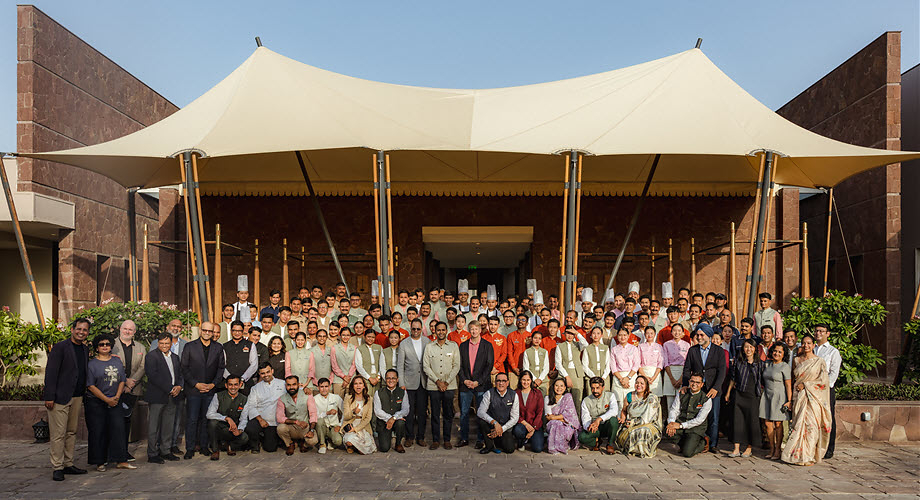
Marriott International reached 10,000 properties globally with the June 2026 opening of the JW Marriott Ranthambore Resort & Spa in Rajasthan, India — a milestone the hospitality giant is timing to its approaching 100th anniversary. For foodservice equipment dealers, manufacturer reps, and consultants, the number is more than a headline: it represents one of the largest sustained commercial kitchen procurement pipelines in the world.
The 127-key resort, situated near Ranthambore National Park and featuring private villas, is the latest addition to the JW Marriott brand, which now counts more than 130 properties across the globe. JW sits within Marriott's luxury tier, a segment that typically demands full-service kitchen buildouts — multi-station cooking suites, walk-in refrigeration, high-capacity warewashing, and dedicated pastry and banquet prep infrastructure — at capital expenditure levels well above select-service builds.
Marriott's broader luxury portfolio spans nearly 700 properties across 74 countries and territories. For equipment dealers and rep agencies with hospitality account books, that scale means recurring replacement cycles, renovation-driven retrofits, and new-build specifications running concurrently across dozens of markets. Consultants specifying luxury hotel kitchens will recognize that JW-tier properties routinely require high-BTU cooking suites, blast-chilling capability for banquet production, and rack-conveyor or flight-type warewashing systems sized for multi-outlet food and beverage operations. Understanding hospitality-driven cooking equipment trends is increasingly essential for reps working the hotel segment.
The Ranthambore opening also underscores the continued geographic diversification of Marriott's development pipeline, with India emerging as a priority growth market. International builds in emerging markets can present distinct equipment specification challenges — voltage and gas-type compatibility, local NSF-equivalent certification requirements, and supply-chain logistics for parts and service — that dealers and consultants embedded in those regions are well-positioned to address.
As the hospitality sector continues post-pandemic expansion, operators and ownership groups are investing heavily in food and beverage programming as a revenue differentiator, particularly at the luxury tier. That investment flows directly into kitchen capital goods. Coverage of broader energy-and-sustainability trends in commercial kitchens is increasingly relevant as hotel brands face ESG reporting pressure and seek ENERGY STAR-qualified equipment to meet portfolio-wide sustainability targets. For additional hospitality foodservice context, Food & Beverage Magazine tracks F&B programming trends across major hotel brands.
Written by Michael Politz, Author of Guide to Restaurant Success: The Proven Process for Starting Any Restaurant Business From Scratch to Success (ISBN: 978-1-119-66896-1), Founder of Food & Beverage Magazine, the leading online magazine and resource in the industry. Designer of the Bluetooth logo and recognized in Entrepreneur Magazine's "Top 40 Under 40" for founding American Wholesale Floral, Politz is also the Co-founder of the Proof Awards and the CPG Awards and a partner in numerous consumer brands across the food and beverage sector.