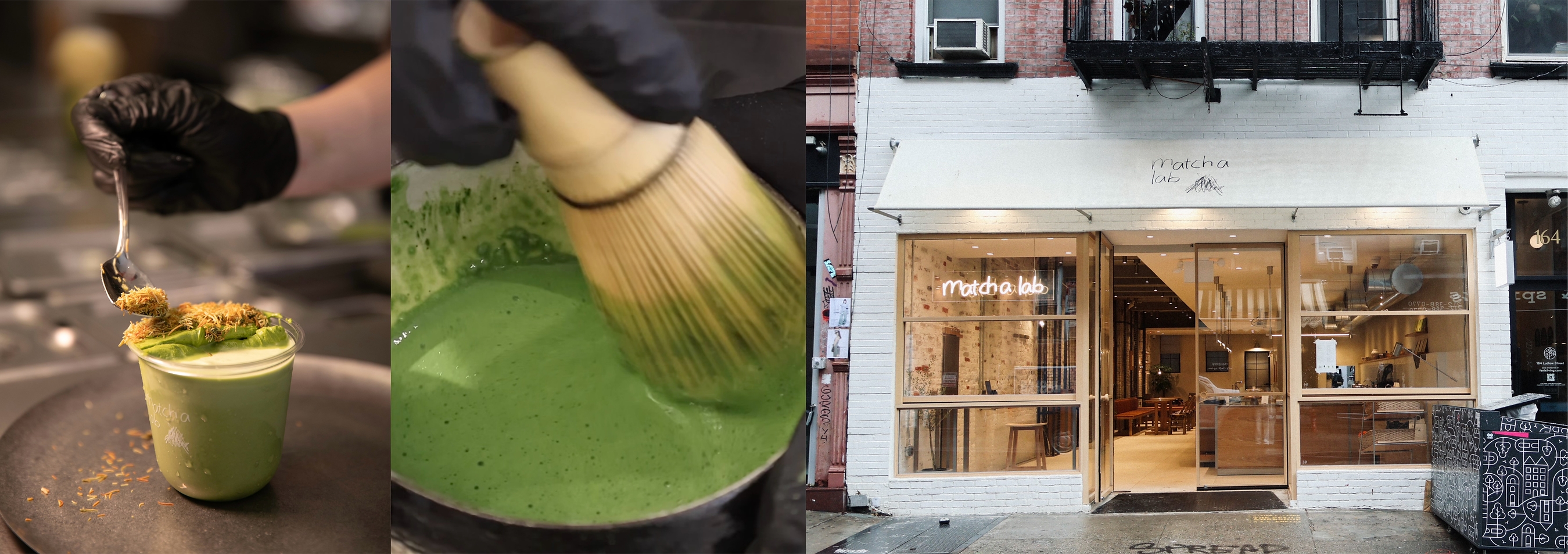
Heytea's newest New York location is built around a single ingredient. The Heytea matcha lab at 164 Ludlow Street on the Lower East Side is the brand's first globally dedicated matcha-only concept, eliminating coffee, ube, and all other categories in favor of an operation entirely engineered around matcha preparation, origin sourcing, and texture experimentation.
The opening is the chain's fourth specialized concept in New York — joining the Times Square heytea lab, an Upper East Side teabar, and a Union Square gelato lab+ — and represents a meaningful back-of-house design commitment. Rather than a standard milk-tea build-out, the store's service infrastructure is organized around hand-whisking stations, a ceremonial-grade matcha program, and a live stone-milling demonstration using an antique mill from Uji, Japan, dating to the shogunate era. Guests can hand-grind tencha — the shade-grown leaf material processed into matcha powder — directly on the floor, adding an educational and experiential dimension rarely seen in quick-service beverage formats.
The Beverage Program
The drink menu draws from two single-origin matcha sources: Jingshan, China, and Shizuoka, Japan. Each is whisked to order and offered at three intensity tiers — M60, M100, and M150 — calibrated by matcha concentration. Jingshan is described as forward in umami with toasted notes; Shizuoka opens with fresh green aromatics and a creamy, sweet finish. Iced versions are served with a matcha ice cube formed from the same concentrate, designed to maintain flavor integrity as the drink dilutes — a spec detail that reflects a deliberate cold-service engineering choice for beverage operators watching dilution control.
The creations menu adds formats built on that base: a Matcha Dirty made with a house-prepared extra-rich matcha sauce rather than espresso, a Pistachio Matcha Dirty finished with pistachio kataifi, a Matcha Latte Float topped with matcha gelato, and a Frozen Yuzu Matcha poured over yuzu-and-apple sorbet. The gelato section extends the matcha intensity scale to four levels — M60 through M200 — indicating a soft-serve or batch-freezer program calibrated for progressive richness rather than a single house blend.
Kitchen and Concept Design
The interior reflects the operational tension between traditional craft and commercial throughput. Exposed brick — some coated in matcha powder — sits opposite pale wood furniture and stainless-steel service accents. Matcha tools and jars of tencha are integrated as functional installations alongside the antique stone mill. A glass façade opens toward the street, supporting visibility for a beverage-forward concept that relies on counter theater as part of its service model.
For foodservice operators and beverage-program designers watching the premium tea segment, the Heytea matcha lab represents a proof-of-concept for mono-ingredient back-of-house specialization — a configuration increasingly relevant as ghost kitchen and commissary formats look to reduce SKU complexity while sharpening product identity. By limiting the menu to matcha across multiple preparation methods, temperature formats, and texture profiles, the store compresses equipment needs while expanding the depth of a single ingredient category.
Heytea operates more than 3,500 stores across 330-plus cities worldwide and more than 45 U.S. locations spanning New York, Los Angeles, the San Francisco Bay Area, Houston, Seattle, and Boston.
Written by Michael Politz, Author of Guide to Restaurant Success: The Proven Process for Starting Any Restaurant Business From Scratch to Success (ISBN: 978-1-119-66896-1), Founder of Food & Beverage Magazine, the leading online magazine and resource in the industry. Designer of the Bluetooth logo and recognized in Entrepreneur Magazine's "Top 40 Under 40" for founding American Wholesale Floral, Politz is also the Co-founder of the Proof Awards and the CPG Awards and a partner in numerous consumer brands across the food and beverage sector.