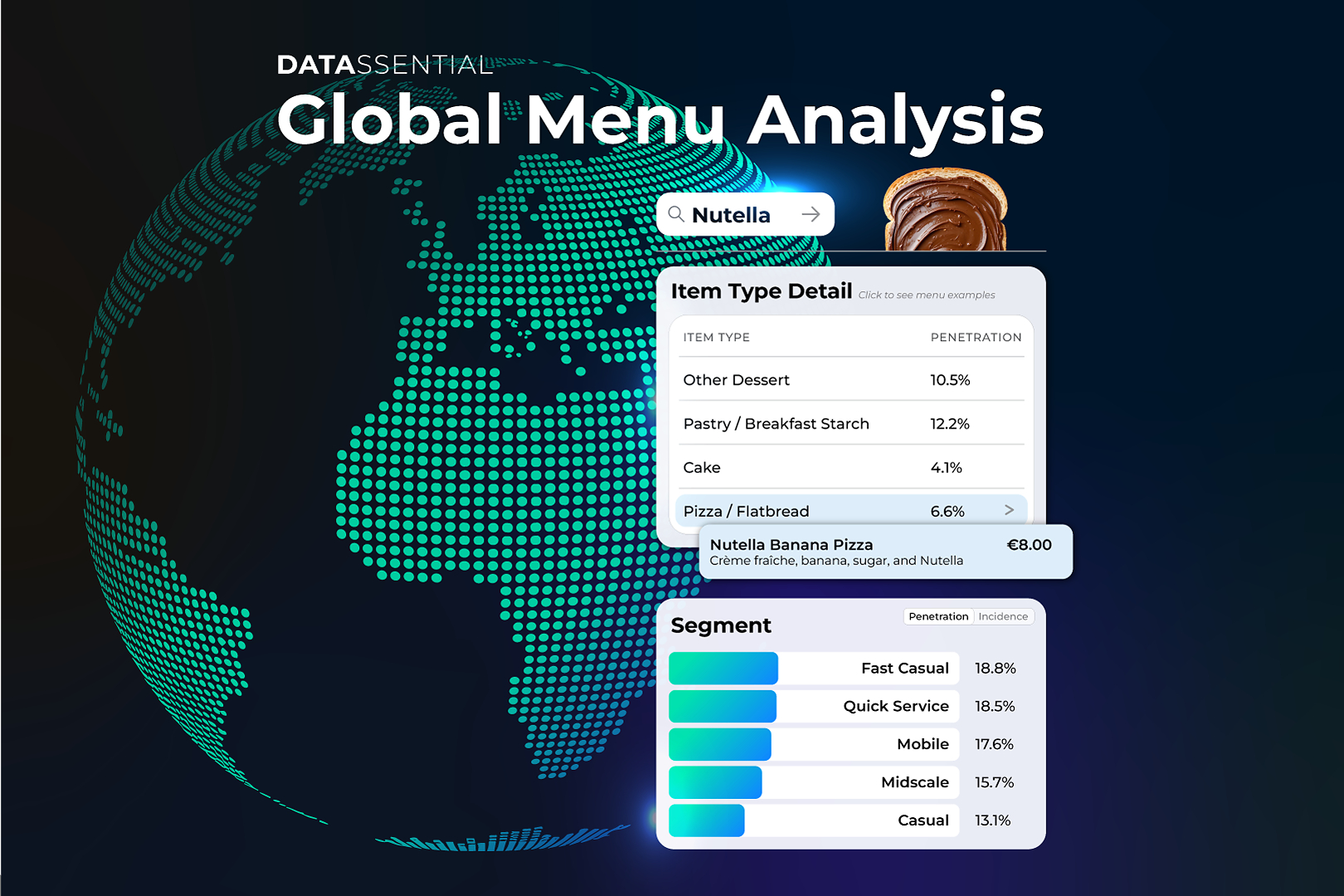
Datassential has rolled out two AI-powered products that give foodservice suppliers, distributors, and equipment sales teams sharper visibility into where menu trends are moving and which operators to target — a capability set built on a database that has more than tripled in scale since January 2026.
The Chicago-based food and beverage intelligence platform introduced Global Menu Analysis and the Datassential AI Agent simultaneously, anchoring both on a newly expanded corpus of 1.4 million restaurant and bar menus across 80-plus countries. The company added menus in 20-plus new countries on six continents this year alone, extending a foundation laid over 25 years of domestic menu trend tracking.
What the Tools Do
Global Menu Analysis lets users query any food, beverage, flavor, or ingredient and retrieve penetration rates, pairing data, price benchmarks, and geographic concentration — from a country-level view down to a single city. For operators specifying menu programs or for equipment reps mapping untapped segments, the tool surfaces which cuisine types, dayparts, and service segments feature a given item most heavily. Sales teams can convert that data directly into prospect lists by identifying operators already menuing a target product, then pulling their profiles from Datassential's database of 13 million-plus foodservice operators.
The Datassential AI Agent extends that operator database into third-party AI environments — including Claude, ChatGPT, and Microsoft Copilot — via the Model Context Protocol (MCP). Users can submit plain-language queries such as "Find me high-volume independents serving birria tacos in Amsterdam" and receive verified, operator-level answers without leaving their existing workflow. The connection is read-only and secure, allowing enterprise teams to blend Datassential intelligence with proprietary CRM and sales data.
Implications for Foodservice Equipment and Distribution
For equipment dealers, manufacturer reps, and consultants, the practical utility lies in market-sizing and whitespace analysis. Identifying cities or segments where a high-throughput cooking category — say, smash-burger stations or automated wok lines — is gaining menu penetration provides a data-backed rationale for targeting specific operators before competitors do. Coming months will also bring Datassential's Menu Adoption Cycle (MAC) framework, calibrated market-by-market, which tracks whether a trend is emerging, growing, or plateauing — a signal that can inform both equipment specification timelines and distributor stocking decisions.
"Our customers have relied on Datassential menu data for decades to decide what to sell, where, and to whom," said Jim Emling, CEO at Datassential. "Bringing that to new markets, with menus and AI built in from day one, is one of the biggest investments we've made."
The dual launch is part of a broader industry push to bring operator-side intelligence closer to the supply chain. As ghost kitchens, commissary buildouts, and multi-concept operators have multiplied, the gap between trend identification and actionable operator targeting has become a friction point for equipment reps and food manufacturers alike. Tools that connect menu signal to a specific operator profile — with address, segment, and volume data — compress that gap considerably. Readers tracking how data platforms intersect with foodservice operator expansion trends or following the dealer channel intelligence space will find the AI Agent's MCP architecture particularly worth monitoring as enterprise AI adoption accelerates across the supply chain.
Written by Michael Politz, Author of Guide to Restaurant Success: The Proven Process for Starting Any Restaurant Business From Scratch to Success (ISBN: 978-1-119-66896-1), Founder of Food & Beverage Magazine, the leading online magazine and resource in the industry. Designer of the Bluetooth logo and recognized in Entrepreneur Magazine's "Top 40 Under 40" for founding American Wholesale Floral, Politz is also the Co-founder of the Proof Awards and the CPG Awards and a partner in numerous consumer brands across the food and beverage sector.