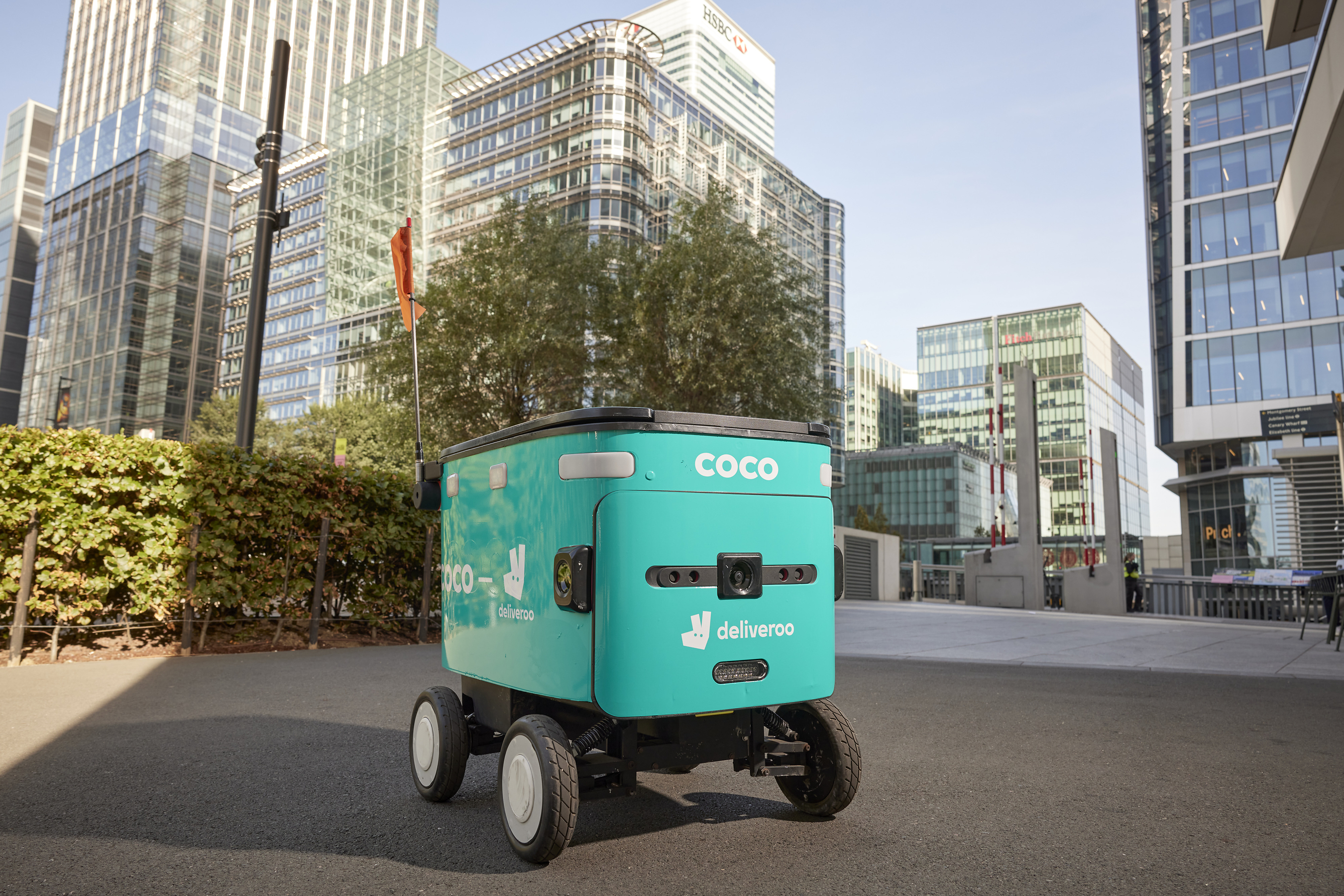
Zero-emission sidewalk robots are coming to the UK foodservice last-mile, as Coco Robotics and Deliveroo launch an exclusive partnership that places autonomous delivery units in London's Canary Wharf beginning October 2026, with rollouts to Milton Keynes, Leeds, Stockton on Tees, and Nottingham to follow in the coming weeks and months.
The deal marks Coco's formal entry into the UK market and Deliveroo's first deployment of autonomous ground-based delivery vehicles in the country. For restaurant operators on the Deliveroo platform — including Canary Wharf anchor tenants Patty&Bun, Signorelli, and Beam, with Ole & Steen, Royal China, and Din Tai Fung slated to join — the fleet adds a supplementary fulfillment channel alongside Deliveroo's existing rider network, offering additional order capacity during peak periods without requiring operators to change anything inside the kitchen.
How the Robots Operate
Coco's robots travel at walking pace along public sidewalks, using onboard sensors, cameras, and AI-driven navigation to process real-time environmental data at the edge — without relying on cloud connectivity. Each unit is designed to yield to pedestrians and move predictably within existing urban traffic flow, with location-specific speed limits and routing policies enforced by Coco's control software. Deployment is phased and aligned with local regulations in each municipality, a model Coco has refined across more than 500,000 zero-emission deliveries completed for over 4,500 restaurants and retailers in the U.S. and Europe since its 2020 founding.
For back-of-house operations teams and ghost kitchen operators, the practical implication is straightforward: orders dispatched through the robot channel are packaged and handed off at the same point of service as any other delivery, with no specialized packaging infrastructure or new equipment required on the operator side. The robot handles the last-mile logistics entirely. That simplicity lowers the barrier to adoption for independent restaurants and commissary operators running tight kitchen footprints — a consideration increasingly relevant as foodservice automation continues to reshape delivery-focused kitchen design.
UK Infrastructure and Accessibility
Coco's UK launch is backed by local investment in operational infrastructure, including new depot and charging facilities in each city — the physical backbone that makes fleet deployment viable at scale. The company will create jobs in operations, maintenance, and logistics across each region, a factor that has helped secure support from local authorities including the Mayor of the East Midlands and the Mayor of Tees Valley.
The partnership also integrates a data-sharing arrangement with BlindSquare, an app used by blind and partially sighted pedestrians. Coco's robots will share real-time sidewalk hazard data — flagging obstacles like discarded e-scooters and temporary construction — directly into BlindSquare's self-voicing navigation app. That capability positions the fleet as more than a delivery tool; it functions as a live urban accessibility sensor network.
On the platform side, Coco already operates with DoorDash and Wolt across Los Angeles, San Jose, Chicago, Miami, Washington D.C., and Helsinki. DoorDash is also developing its own in-house autonomous ground robot, Dot, currently operating in the Phoenix metro area. The UK expansion through Deliveroo — itself a DoorDash subsidiary since 2025 — extends that multi-platform autonomous delivery strategy into a new regulatory environment and represents a broader signal that last-mile robotics infrastructure is maturing beyond U.S. pilot markets into full commercial rollout.
For foodservice operators evaluating delivery channel strategy, the Coco-Deliveroo model offers a template: zero-emission, pedestrian-scale robots that integrate directly with existing ordering platforms, require no kitchen-side capital investment, and scale city by city as local approvals are secured.
Written by Michael Politz, Author of Guide to Restaurant Success: The Proven Process for Starting Any Restaurant Business From Scratch to Success (ISBN: 978-1-119-66896-1), Founder of Food & Beverage Magazine, the leading online magazine and resource in the industry. Designer of the Bluetooth logo and recognized in Entrepreneur Magazine's "Top 40 Under 40" for founding American Wholesale Floral, Politz is also the Co-founder of the Proof Awards and the CPG Awards and a partner in numerous consumer brands across the food and beverage sector.